


Your First Step After an Injury on Someone’s Property

When you enter a grocery store, office building, or someone’s home, you expect to be safe. You don’t anticipate that a wet floor without a warning sign, a broken staircase, or inadequate security will leave you with serious injuries. Yet premises liability accidents happen every day in Houston, and the consequences can be devastating—both physically and financially.
Property owners in Texas have a legal duty to maintain safe conditions. When they fail, and you’re injured as a result, you have the right to seek compensation. However, securing that compensation is rarely straightforward. Insurance companies work to minimize payouts, property owners may deny responsibility, and the legal requirements to prove your claim are complex.
When you’re searching for a Houston premises liability lawyer, you likely need help with:
Key Services a Houston Premises Liability Lawyer Provides:
- Free case evaluation to determine if you have a valid claim
- Evidence preservation through spoliation letters to secure surveillance footage and witness statements
- Investigation of the dangerous condition that caused your injury
- Negotiation with property owners and their insurance companies
- Litigation if a fair settlement cannot be reached
- Damage calculation for medical bills, lost wages, pain and suffering, and future expenses
This guide will walk you through what you need to know about premises liability law in Houston. You’ll learn about the types of cases, what damages you can recover, and the critical steps to take after an accident.
I’m Brian Nguyen, co-founder and Managing Partner of Universal Law Group, where I lead our personal injury division. With experience as a former Assistant District Attorney and years practicing personal injury law in Houston, I’ve helped countless clients steer the complexities of Houston premises liability lawyer claims and secure the compensation they deserve.
What is Premises Liability Law in Houston, Texas?
At its core, premises liability law holds property owners accountable when someone is hurt on their property due to unsafe conditions. If you slip on a wet floor at a grocery store, trip over broken pavement at an apartment complex, or are injured due to inadequate security, the property owner may be legally responsible for your injuries.
The foundation of this law is simple: property owners have a legal duty to maintain a safe environment for people lawfully on their premises. This is outlined in Texas law, including the Texas Civil Practice and Remedies Code. Property owners are expected to regularly inspect their property, fix dangerous conditions, or provide clear warnings. When they fail, they can be held liable for the victim’s medical bills, lost wages, and other damages.
It’s not always just the property owner who can be held responsible. Liability can extend to tenants, property management companies, or maintenance contractors whose negligence created or failed to fix a dangerous condition. As your Houston premises liability lawyer, we investigate every angle to determine who should be held accountable.
More info about How Premises Liability Works
The Critical Role of Visitor Status
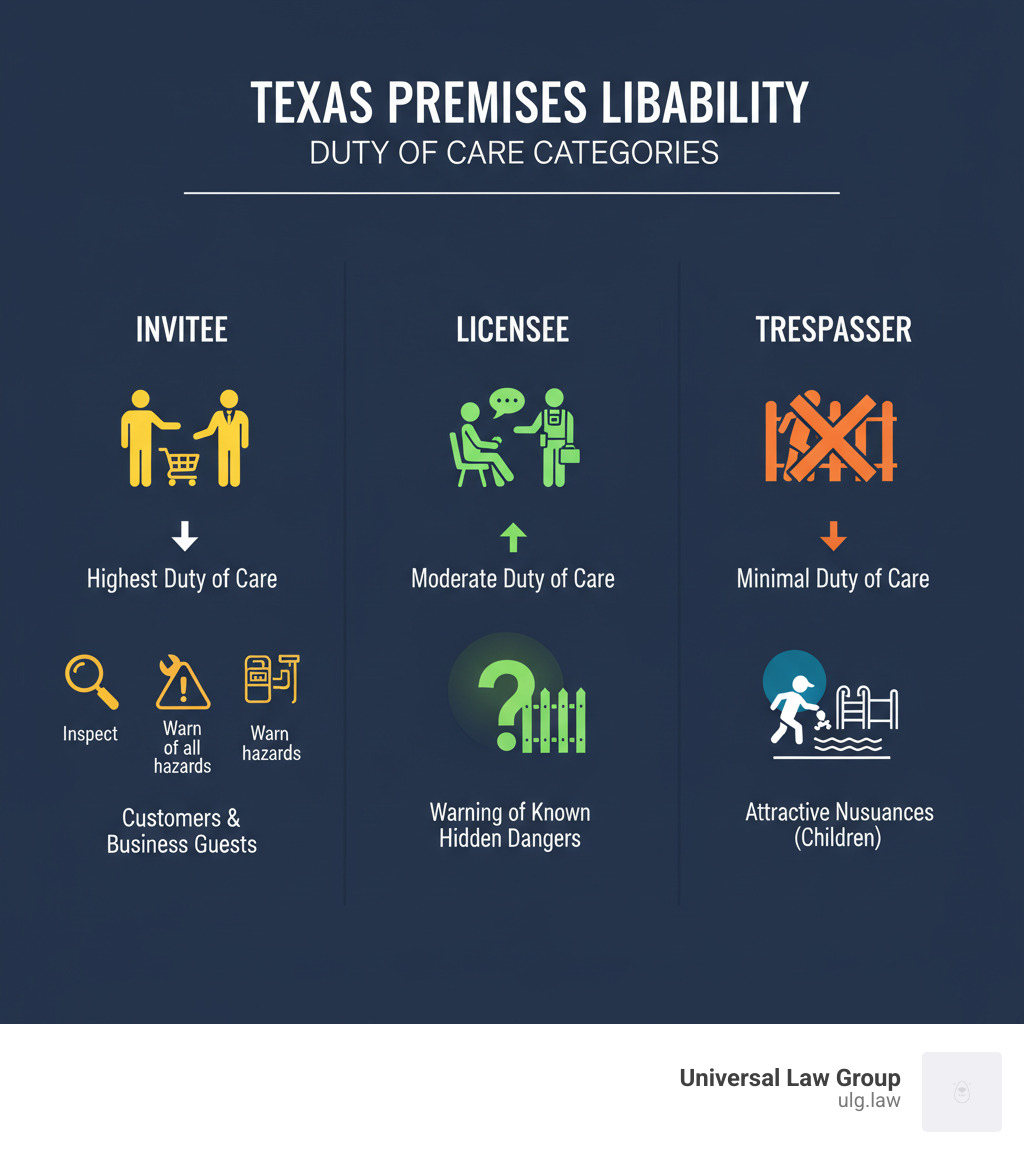
Texas law doesn’t treat all visitors the same. The duty a property owner owes you depends on your legal status when you were on their property. Understanding your visitor status is critical because it determines what the property owner should have done to keep you safe.
| Legal Status | Definition | Example | Duty of Care Owed by Property Owner |
|---|---|---|---|
| Invitee | Enters property with owner’s knowledge and for mutual benefit (usually commercial) | Customer in a grocery store, patient at a clinic | Highest duty: Must inspect for, find, repair, or warn of all known and unknown dangerous conditions |
| Licensee | Enters property with owner’s consent for their own convenience or social purposes | Social guest at a friend’s home, meter reader | Moderate duty: Must warn of known hidden dangers, but no duty to inspect for unknown dangers |
| Trespasser | Enters property without any right, invitation, or permission | Someone breaking into a building, shortcut through private land | Minimal duty: No duty of care, but cannot intentionally injure (e.g., set booby traps) |
Invitee Duty
An invitee is someone on a property for the owner’s business benefit, like a customer in a store. Property owners owe invitees the highest standard of care. They must actively inspect their property for dangers, repair hazards, and provide clear warnings. This high standard exists because the owner benefits financially from the invitee’s presence.
Licensee Duty
A licensee enters a property with permission but not for business purposes, like a social guest at a friend’s home. The property owner has a more limited duty: they must warn you about known hidden dangers. However, they generally don’t have a duty to inspect for unknown hazards.
Trespasser Duty
A trespasser enters a property without permission. Generally, property owners owe no duty to trespassers, but they cannot intentionally injure them (e.g., by setting traps).
Attractive Nuisance Doctrine
Texas law makes a special exception for children with the Attractive Nuisance Doctrine. This doctrine recognizes that children may not understand certain dangers. If a property owner has a condition likely to attract children that poses a risk of serious injury—like an unfenced swimming pool or an unsecured construction site—they have a heightened duty to protect children, even if they are trespassing. The owner must take reasonable steps, such as installing fences and gates, to prevent foreseeable harm to children.
Understanding your visitor status is fundamental to a premises liability case. An experienced Houston premises liability lawyer can establish your status and the duties the property owner owed you.
For more information on property safety standards in Houston, the City of Houston provides helpful resources at Information for Houston residents.
Building a Winning Case: The Four Pillars of a Premises Liability Claim

Getting hurt on someone’s property doesn’t automatically mean you have a valid claim. To win a premises liability case in Texas, you must prove a clear connection between the property owner’s negligence and your injuries. As your Houston premises liability lawyer, we build your case on four essential elements of negligence.
Pillar 1: Proving the Property Owner Owed You a Duty of Care
First, we must establish that the property owner had a legal responsibility, or “duty of care,” to keep you safe. This duty depends on your visitor status. If you were an invitee (like a customer), the owner owed you the highest duty: to inspect for dangers, repair them, and warn you of any hazards. For licensees (social guests), the duty is to warn of known dangers. For trespassers, the duty is minimal, except in cases involving children and attractive nuisances. Establishing this duty is the foundation of your claim.
Pillar 2: Showing the Property Owner Breached Their Duty
Next, we must show the property owner failed to meet their duty of care. This failure, or “breach,” can happen in several ways:
- The owner or their employee created the hazard (e.g., mopping a floor without a warning sign).
- The owner had actual knowledge of a danger but did nothing.
- The owner had constructive knowledge, meaning the hazard existed for so long that a reasonable owner should have finded it through regular inspections.
- The owner failed to inspect the property for potential dangers as required.
We use evidence like maintenance records, surveillance footage, and witness statements to prove this breach.
More info about our Houston Premises Liability Lawyer services
Pillar 3: Linking the Breach Directly to Your Injuries (Causation)
Proving a breach isn’t enough; we must also prove that the breach directly caused your injuries. This is “causation.” We must show that “but for” the owner’s negligence, you would not have been hurt. For example, but for the unmarked wet floor, you would not have slipped and broken your ankle.
We also have to prove foreseeability—that a reasonable person could have foreseen that this type of negligence would lead to this type of injury. A slip-and-fall is a foreseeable result of an uncleaned spill. We use medical records and expert testimony to create a clear link between the accident and the specific harm you suffered.
Pillar 4: Documenting Your Damages
The final pillar is proving your losses, or “damages.” This is the basis for the compensation we seek on your behalf. Damages fall into two main categories:
- Economic Damages: These are tangible financial losses with a specific dollar amount. They include past and future medical bills, lost wages, and loss of future earning capacity.
- Non-Economic Damages: These are intangible losses that affect your quality of life. They include pain and suffering, mental anguish, physical impairment or disfigurement, and loss of enjoyment of life.
In rare cases of extreme negligence, we may also seek punitive damages to punish the defendant and deter similar conduct. We carefully document every loss to ensure you receive full and fair compensation.
More info about Personal Injury in Houston
Common Accidents, Serious Injuries, and What to Do Next
Premises liability injuries often stem from seemingly mundane hazards that property owners created or ignored. These accidents can cause injuries with lifelong consequences. Knowing the common causes and what to do immediately after an accident can protect your health and your legal rights.
Common Causes of Premises Liability Accidents in Houston
- Slip and Fall Accidents: Caused by wet floors from spills or mopping, slick surfaces, and other hazards without proper warning.
- Trip and Fall Accidents: Resulting from uneven surfaces like cracked pavement, potholes, cluttered aisles, or loose flooring.
- Poor Lighting: Inadequate lighting in stairwells, hallways, and parking lots can hide dangerous conditions and lead to falls or assaults.
- Negligent Security: Failure to provide adequate security (e.g., working locks, security personnel, sufficient lighting) in areas where crime is foreseeable can lead to liability for assaults and robberies.
- Falling Objects: Items improperly stacked on high shelves or unsecured materials at construction sites can cause severe head and body injuries.
- Swimming Pool Accidents: Unfenced or unsupervised pools pose a significant drowning risk, especially to children under the attractive nuisance doctrine.
- Other Hazards: Dog bites, fires from faulty wiring, and broken staircases or elevators can also lead to devastating injuries.
Information for Houston residents
The Devastating Impact: Types of Injuries Sustained
The injuries from these accidents can be severe and life-altering:
- Fractures: Broken hips, wrists, and ankles are common in falls and can require surgery and extensive rehabilitation.
- Traumatic Brain Injuries (TBI): Concussions and severe TBIs can result from falls or impacts, causing long-term cognitive, emotional, and memory problems.
- Spinal Cord Injuries: Damage to the spinal cord can lead to chronic pain, herniated discs, nerve damage, or even paralysis.
- Burns and Lacerations: Fires, explosions, or sharp objects can cause painful burns, deep cuts, permanent scarring, and disfigurement.
- Wrongful Death: In the most tragic cases, accidents like drownings or severe falls can be fatal, leaving families with emotional and financial devastation.
Your Immediate Action Plan After an Accident
What you do in the moments after an accident is critical. Follow these steps to protect your health and your potential claim.

- Seek Immediate Medical Attention: Your health is the priority. Adrenaline can mask serious injuries. A medical evaluation creates an official record linking your injuries to the accident.
- Report the Incident: Inform the property owner or manager immediately. Ask for a copy of a written incident report.
- Document the Scene: Use your phone to take photos and videos of the hazard and the surrounding area. This evidence is perishable and can be cleaned up or repaired quickly.
- Get Witness Information: Ask anyone who saw the accident for their name and phone number. Independent witnesses are invaluable.
- Preserve Your Clothing and Shoes: Do not wash or discard the items you were wearing. They can be important evidence.
- Do Not Give a Recorded Statement: Politely decline to give a recorded statement to the owner’s insurance company. They are trained to use your words against you. Tell them you will speak with them after consulting an attorney.
- Contact a Houston Premises Liability Lawyer: The sooner you call, the sooner we can preserve evidence and protect your rights. We will handle communications with the insurance company so you can focus on healing.
More info on What to Bring to a Personal Injury Consultation
Why Hiring the Right Houston Premises Liability Lawyer is Crucial

After an injury, you face physical pain, mounting medical bills, and lost wages. Hiring the right Houston premises liability lawyer is crucial because these cases are complex, and you will be up against aggressive insurance companies and property owners who deny responsibility. You need a skilled advocate in your corner.
Navigating Insurance Company Tactics and Common Defenses
Insurance companies are businesses focused on minimizing payouts. Their adjusters will use a playbook of tactics to devalue or deny your claim:
- Requesting a Recorded Statement: They will ask leading questions to trap you into admitting fault or downplaying your injuries.
- The “Open and Obvious” Defense: They will argue the hazard was so obvious that you should have seen and avoided it, placing the blame on you for not paying attention.
- Blaming the Victim: This strategy ties into Texas’s Modified Comparative Fault Rule. Under this 51% bar rule, you cannot recover any damages if you are found to be 51% or more at fault. If you are less than 51% at fault, your compensation is reduced by your percentage of fault. Insurers will aggressively try to shift as much blame as possible onto you.
- Claiming Lack of Knowledge: The owner will claim they didn’t know about the dangerous condition. We counter this by proving they had “constructive knowledge”—that they should have known about it.
More info on Don’t Get Injured Twice: Personal Injury Legal Advice for Your Claim
How an Experienced Houston Premises Liability Lawyer Builds Your Case
At Universal Law Group, we take a proactive approach to building your case from day one.
- Thorough Investigation: We visit the scene, interview witnesses, and gather all reports and records.
- Evidence Preservation: We immediately send spoliation letters, which are legal notices demanding that the property owner preserve all evidence, such as surveillance footage and maintenance logs. If they destroy evidence after receiving this letter, they can face serious legal penalties.
- Hiring Expert Witnesses: We may work with accident reconstructionists to prove how the accident happened and medical experts to testify about the severity and future costs of your injuries.
- Aggressive Negotiation and Litigation: As former prosecutors, we know how to build a persuasive case and negotiate from a position of strength. We handle all communications with insurers, protecting you from their tactics. If they refuse to offer a fair settlement, we are fully prepared to take your case to court.
What Kind of Compensation Can You Recover?
Texas law allows you to seek compensation for a wide range of damages, including:
- Medical Expenses: All past and future costs for treatment, therapy, and medication.
- Lost Wages and Earning Capacity: Income lost while unable to work and compensation for a reduced ability to earn in the future.
- Pain and Suffering: Compensation for the physical pain and emotional distress caused by the injury.
- Physical Impairment and Disfigurement: Damages for permanent limitations, scarring, or alteration to your appearance.
- Loss of Consortium: Compensation for the negative impact the injury has on a marital relationship.
- Punitive Damages: In cases of extreme negligence, these damages may be awarded to punish the defendant.
We carefully assess all these categories to pursue the maximum compensation you deserve.
More info about Personal Injury in Houston
Frequently Asked Questions about Houston Premises Liability Claims
We understand you have questions. Here are answers to some of the most common concerns we hear from clients about premises liability claims in Houston.
What is the statute of limitations for a premises liability claim in Texas?
In Texas, you generally have two years from the date of your accident to file a lawsuit, as dictated by the Texas Civil Practice and Remedies Code § 16.003. If you miss this deadline, you will lose your right to seek compensation.
This deadline is strict. There are very few exceptions, such as the “findy rule,” which may apply if you could not have reasonably known about your injury right away. Furthermore, if your injury occurred on government property (like a city park or public building), the Texas Tort Claims Act requires you to provide written notice of your claim within just 180 days (six months). Due to these deadlines, it is critical to contact a Houston premises liability lawyer as soon as possible.
Information for Houston residents
Can I still file a claim if I was partially at fault for the accident?
Yes, in many cases you can. Texas follows a 51% modified comparative fault rule. This means you can recover compensation as long as you are not found to be 51% or more at fault for the accident.
If you are found partially at fault (but 50% or less), your total compensation will be reduced by your percentage of fault. For example, if you were awarded $100,000 but found to be 20% at fault, you would receive $80,000. Because of this rule, insurance companies will work hard to shift blame onto you to reduce or eliminate their payout. We know how to fight these tactics and protect your right to fair compensation.
More info on Don’t Get Injured Twice: Personal Injury Legal Advice for Your Claim
How much does it cost to hire a premises liability lawyer?
At Universal Law Group, we handle all premises liability cases on a contingency fee basis. This means you pay nothing unless we win your case.
- No Upfront Costs: We cover all costs of investigating and litigating your case, such as hiring experts and filing fees.
- No Fee Unless You Win: Our fee is a percentage of the compensation we recover for you. If we don’t secure a settlement or verdict in your favor, you owe us nothing for our legal services.
- Free Initial Consultation: We offer a free, no-obligation consultation to discuss your case, answer your questions, and explain your legal options.
This “no win, no fee” promise ensures that everyone can afford quality legal representation, regardless of their financial situation. It allows you to focus on your recovery while we focus on fighting for you.
More info about our Houston Premises Liability Lawyer services
Secure the Justice and Compensation You Deserve
An injury on someone else’s property can turn your life upside down, leaving you with physical pain, emotional stress, and financial burdens. You need to know that you have rights. Texas law holds negligent property owners accountable, and you deserve compensation for the harm you’ve suffered.
However, securing that compensation is a battle. Insurance companies use aggressive tactics to deny claims, and the legal process is complex. This is why prompt action and expert legal guidance are essential. Evidence can disappear, and the two-year statute of limitations in Texas means you cannot afford to wait.
At Universal Law Group, we provide the personalized, efficient, and responsive service you deserve. As a Houston premises liability lawyer team with former prosecutor experience, we know how to build a powerful case and fight for the maximum settlement. We handle everything on a contingency fee basis, so you pay nothing unless we win.
You’ve already been injured by someone’s negligence. Don’t be victimized again by accepting less than you deserve. Contact our Houston premises liability team today for a free consultation. Let us fight for the justice and compensation you need to heal and move forward.