
Beyond the Bump: Understanding Workplace Injuries Like Falling Objects and Chemical Exposure
Understanding the True Cost of Workplace Struck-By Incidents
Falling object injury incidents are one of the most devastating yet preventable workplace hazards. These accidents occur when tools, equipment, or materials drop from liftd surfaces and strike workers below, often with catastrophic consequences.
Key Facts About Falling Object Injuries:
- 238 fatalities annually from falling objects, representing 48% of all “struck-by” incidents
- 52,000+ workers injured each year by dropped or falling objects
- $345 million in total costs from fatal accidents alone (238 fatalities × $1.45M average)
- Even a 2-ounce pen falling from 230 feet can penetrate a safety hard hat
- 4% of all workplace injuries result from falling objects or equipment
These aren’t abstract statistics—they represent real people whose lives are changed in an instant. From construction sites in Houston to warehouses in Dallas, falling object injuries affect workers across Texas daily. The severity ranges from minor cuts to traumatic brain injuries that leave victims permanently disabled and unable to care for their families.
Common falling objects include hand tools, fasteners, building materials, and equipment. While the construction industry bears the heaviest burden, these hazards exist in telecommunications, oil and gas, manufacturing, and warehousing. Tragically, these injuries are almost always preventable through proper safety controls and procedures.
I’m Brian Nguyen, Managing Partner at Universal Law Group and a former Assistant District Attorney, and I’ve witnessed how falling object injury cases devastate families while employers and insurers try to minimize responsibility. My experience has shown me that understanding your rights is the first step toward recovery and justice.
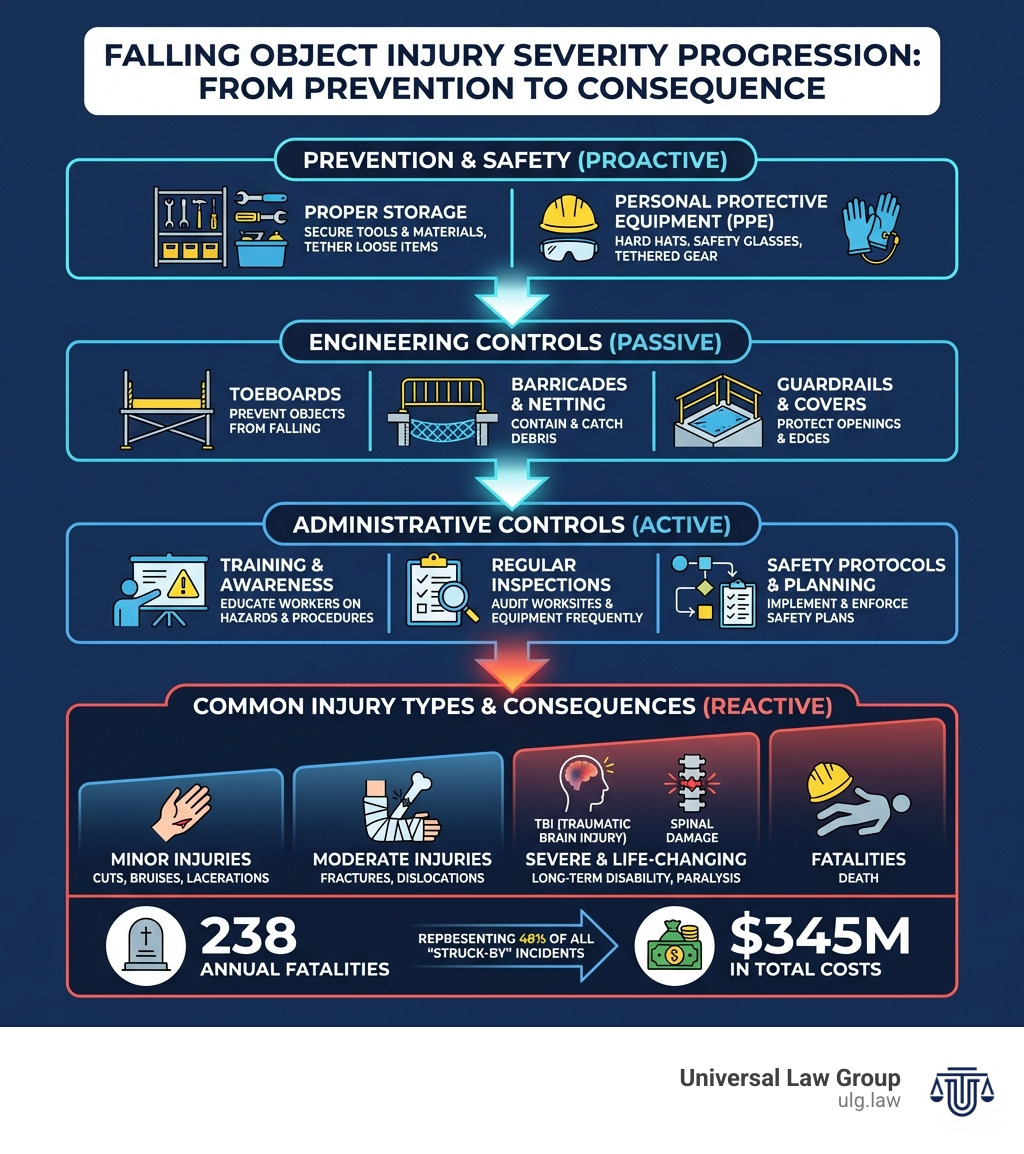
Key Takeaways
-
Falling objects kill and injure thousands each year: These incidents cause 238 deaths and over 52,000 injuries annually, with massive financial impact.
-
Most incidents are preventable: Poor storage, unsecured tools, and weak safety controls create avoidable risks.
-
Small objects can cause severe harm: Injury severity depends on height, weight, and impact location, often leading to TBI or spinal damage.
-
Strong safety systems reduce risk: Engineering controls and training prevent drops; PPE only reduces impact.
-
Texas workers may pursue compensation: Legal options depend on employer status and third-party liability.
The Physics of Danger: Causes and Types of Falling Object Incidents
A falling object injury isn’t a “freak accident”; it’s a predictable outcome when safety protocols are ignored. Categorized by OSHA as “struck-by hazards,” these incidents are a leading cause of serious injury and death in construction, but the risks extend to warehouses, industrial sites, and more.
The common causes are often rooted in preventable errors:
- Improper storage: Items stacked too high or too close to edges.
- Unsecured tools: Tools left unattended on liftd surfaces.
- Weather effects: Wind dislodging materials or equipment.
- Equipment malfunction: Faulty cranes, hoists, or scaffolding leading to dropped loads.
- Human error: Accidental drops by workers, or items kicked off platforms.
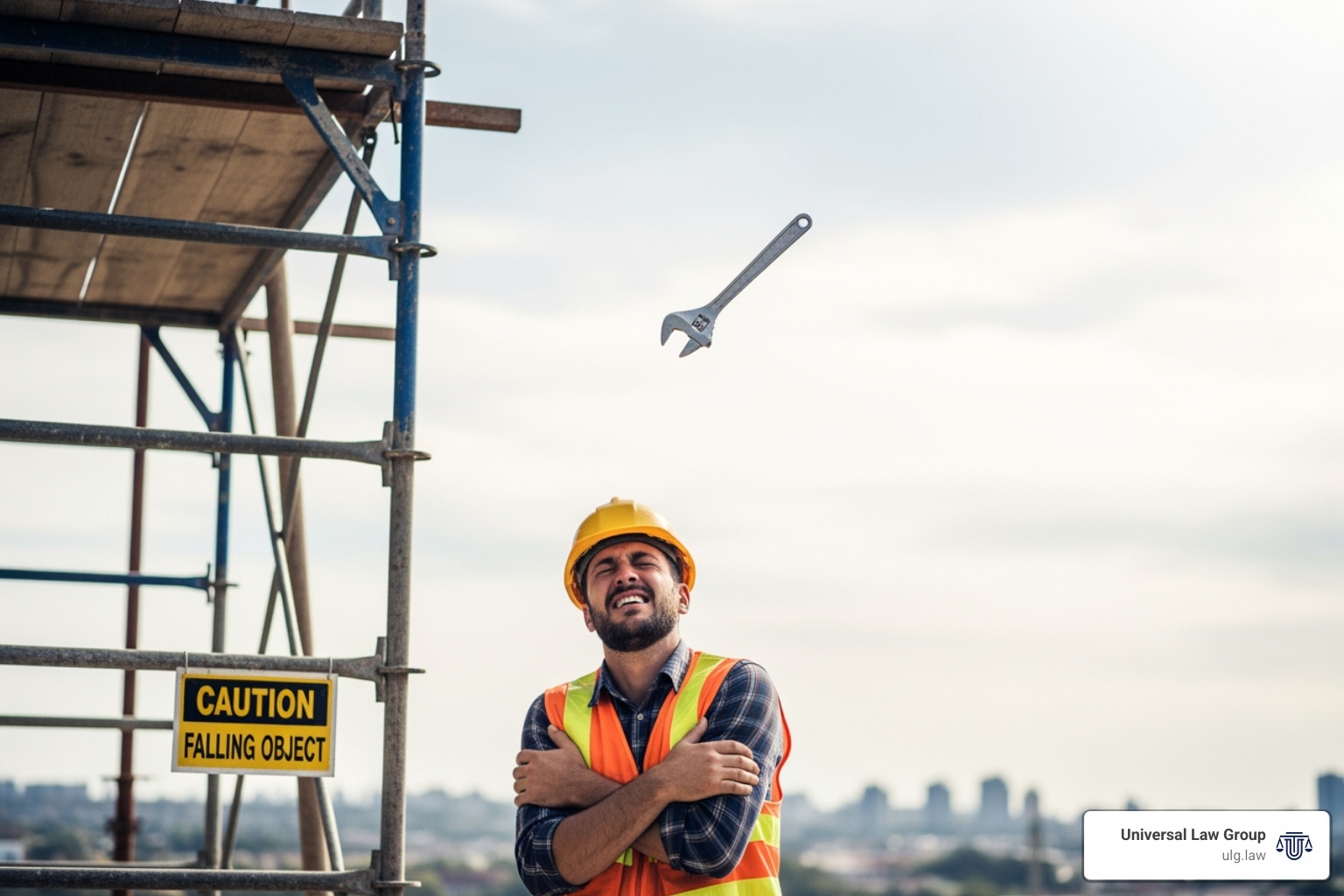
Common objects that frequently fall and cause injuries include drills, hammers, screws, scaffolding parts, paint cans, boards, power tools, and personal items like phones or water bottles.
Static vs. Dynamic Falling Objects
To effectively prevent a falling object injury, it’s important to understand the two main categories:
- Static Falling Objects: These objects fall from a stationary position under their own weight, often due to material fatigue, corrosion, or structural weakness. Examples include a corroded railing breaking off or a handle snapping from a bucket.
- Dynamic Falling Objects: These objects fall because of a secondary force, such as a worker accidentally dropping a tool, an item being kicked off a ledge, or materials dislodged by a vehicle. These incidents often point to issues with work practices or training.
Understanding this distinction helps tailor prevention strategies for both structural integrity and safe work practices.
Common Scenarios Leading to a Falling Object Injury
Falling object incidents are rarely random. Common scenarios include:
- Improperly Stacked Materials: Materials stacked too high, unevenly, or without securing can easily topple over near edges.
- Unsecured Loads During Hoisting: If crane loads aren’t properly balanced and secured, items can shift and fall. The IHSA warns that every load must be confirmed as balanced and secured before lifting.
- Tools Left on Liftd Surfaces: Leaving tools on guardrails or ledges is a dangerous habit, as a simple vibration or gust of wind can send them plummeting.
- Debris Knocked from Height: During demolition or renovation, debris can be dislodged if work areas aren’t properly contained.
- Lack of Toeboards or Netting: These essential controls prevent objects from being kicked or rolling off an edge.
As the IHSA notes, falling-object hazards are everywhere, from large beams to small fasteners and hand tools.
Industries at High Risk
While construction is a primary concern, the potential for a falling object injury exists across many industries where work is performed at height:
- Construction: High-rise buildings, residential developments.
- Oil and Gas: Rigs and refineries in Texas often involve work at height with heavy equipment.
- Manufacturing: Factories with overhead cranes and tall storage.
- Telecommunications: Tower climbers and maintenance crews.
- Warehousing: High shelving and constant movement of inventory.
- Transportation: Loading/unloading cargo, vehicle maintenance.
- Nuclear Facilities and Wind Energy: Specialized environments with unique height-related risks.
Any workplace where tools or materials are liftd carries an inherent risk that must be actively managed.
The Devastating Impact of a Falling Object Injury
The consequences of a falling object injury can range from minor scrapes to life-altering trauma or death. The severity depends on a combination of critical factors:
- Object Weight: A heavier object carries more kinetic energy.
- Object Shape: A pointed object can penetrate, while a blunt object can crush.
- Fall Height: Greater height increases the object’s velocity and impact force. A solid object dropped from 106 feet hits the ground at 65.8 miles per hour.
- Impact Location: A blow to the head, neck, or spine is far more dangerous than to an extremity.
- Protective Gear Worn: PPE like hard hats can mitigate the severity of some impacts but are not a complete safeguard.
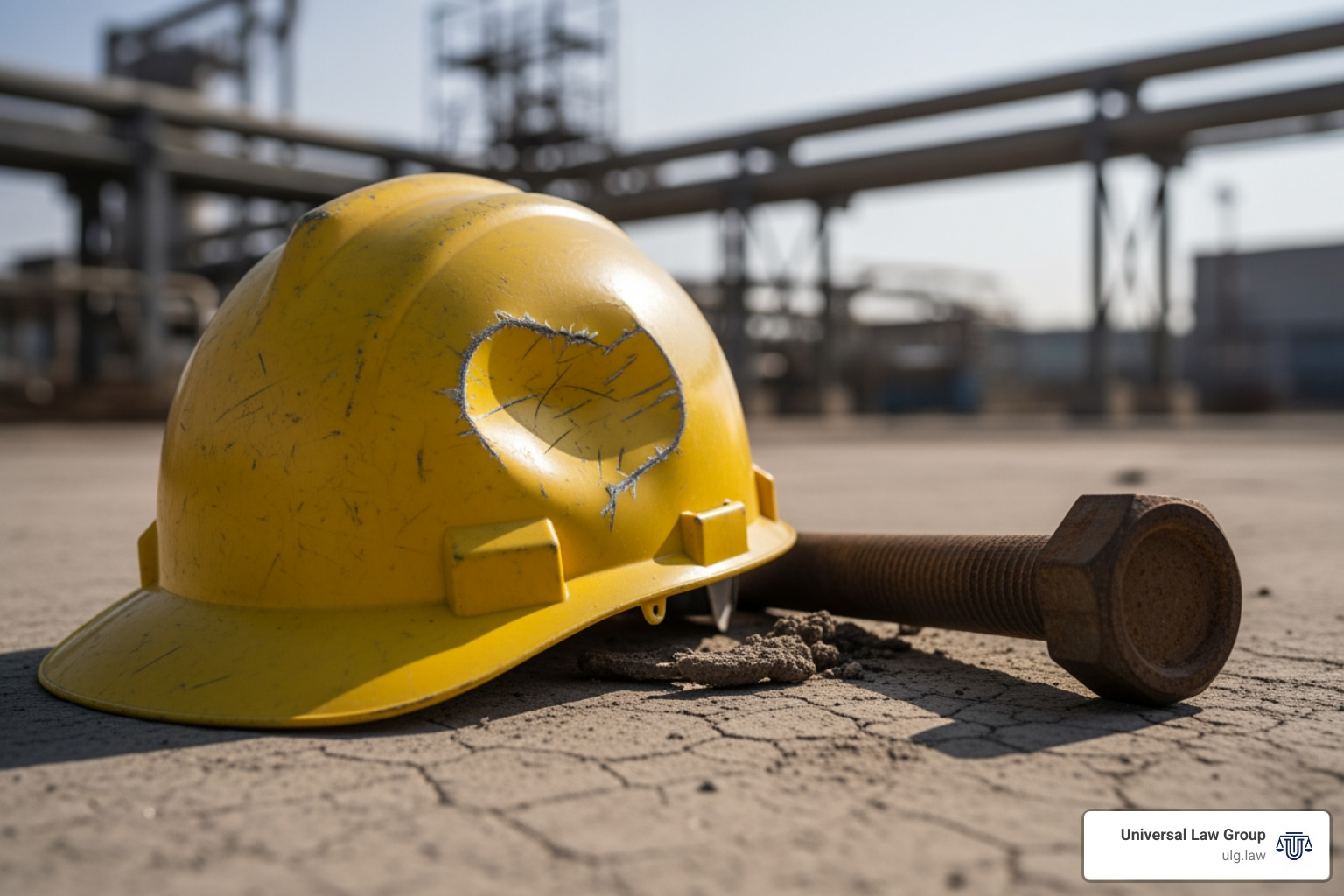
Common Types of Injuries
Even seemingly minor objects can cause significant harm, including cuts, lacerations, bruises, sprains, fractures, and neck or back injuries. In some severe cases, victims suffer from degloving injuries, which are particularly painful. For more information, see our An Essential Guide to Degloving Injury.
Severe and Life-Altering Consequences
Beyond immediate injuries, a falling object injury can lead to profoundly severe consequences:
- Traumatic Brain Injuries (TBI): These are alarmingly common. Even a small tool can cause a concussion or skull fracture. Learn more on our Brain Injuries page.
- Spinal Cord Damage & Paralysis: Impacts to the back or neck can damage the spinal cord, potentially resulting in paralysis.
- Internal Injuries: Heavy falling objects can cause blunt force trauma, leading to organ damage or internal bleeding.
- Amputation: In tragic cases, severe crush injuries may necessitate amputation. Our Houston Amputation Lawyer team is here to help.
- Wrongful Death: Tragically, 238 workers lose their lives each year to falling objects, leaving families to cope with unimaginable grief.
The Long-Term Toll of a Falling Object Injury
The impact of a severe falling object injury extends far beyond physical pain. Victims often face a long-term toll affecting every aspect of their lives:
- Permanent Disability and Inability to Work: Loss of earning capacity can plunge families into financial crisis.
- Chronic Pain: Lingering pain can become a constant companion, reducing quality of life.
- Financial Strain: Medical bills, rehabilitation costs, and lost wages create an overwhelming burden.
- Psychological Trauma: Living through a traumatic accident can lead to PTSD, anxiety, and depression.
- Reduced Quality of Life: The cumulative effect of these challenges can severely diminish a person’s enjoyment of life.
Understanding the full scope of these damages is crucial when pursuing compensation. Our team is well-versed in fighting for Pain and Suffering Damages to ensure our clients receive the justice they deserve.
The Hierarchy of Controls: Proactive Prevention Strategies
At Universal Law Group, we believe nearly every falling object injury is preventable. Safety experts use the “Hierarchy of Controls” to prioritize prevention methods, from the most effective (Elimination) to the least (Personal Protective Equipment).
While PPE is important, it’s the last line of defense. The most effective strategies are engineering and administrative controls that prevent objects from falling in the first place.
Engineering Controls: Designing Safety into the Worksite
Engineering controls are physical modifications to the workplace that reduce hazards. For falling objects, these are critical:
- Barricades and Exclusion Zones: Physically blocking off areas below overhead work to keep workers out of the “drop zone.”
- Toe Boards: Vertical barriers at least 3.5 inches (89 mm) high along the edge of liftd platforms to stop tools and debris from sliding off.
- Guardrails: Standard systems around platforms and openings to prevent both workers and objects from falling.
- Safety Netting & Debris Nets: Installed below work areas to catch falling objects before they can strike anyone.
- Catch Platforms: Similar to nets, these are designed to intercept falling debris.
- Overhead Protective Structures: Canopies installed over walkways to shield workers.
- Tool Lanyards and Tethers: These connect tools to a worker’s harness, preventing them from falling if dropped. The CDC offers detailed Solutions for Falling Objects & Dropped Tools.
Administrative Controls: Implementing Safe Work Practices
Administrative controls are changes to work procedures that reduce hazard exposure:
- Good Housekeeping: Keeping liftd work areas tidy and removing tools and materials immediately after use.
- Proper Material Stacking: Storing materials at least 6 feet (1.8 meters) from any edge. Stacks should be stable and secured.
- Securing Loads Before Lifting: Before any hoist operation, workers must confirm the load is balanced and secured.
- Worker Training Programs: Comprehensive training on hazard identification, proper material handling, and tool tethering.
- Proactive Hazard Reporting: Encouraging workers to immediately report potential falling object hazards.
- Job Hazard Analysis (JHA): Systematically reviewing tasks to identify risks and develop safe procedures.
- Signallers for Crane Operations: Using a dedicated signaller if an operator’s view is obstructed. The IHSA is blunt: never lift a load over someone’s head.
The Last Line of Defense: The Role of Personal Protective Equipment (PPE)
While other controls are paramount, PPE provides an essential last defense against a falling object injury. It reduces the severity of an impact but does not eliminate the hazard.
Common PPE includes:
- Hard Hats: Designed to protect the head from impact. OSHA and NIOSH emphasize that struck-by falling objects are a major killer, and employers must control the source, not just rely on PPE.
- Safety Glasses/Goggles: Protect eyes from smaller falling debris.
- Steel-Toed Boots: Protect feet from dropped heavy objects.
- Tool Lanyards and Tethers: A form of PPE that physically prevents tools from falling.
We advocate for workplaces that prioritize upstream controls, minimizing the risk of a falling object injury long before PPE is necessary.
Legal Responsibility and Your Rights After an Accident
When a falling object injury occurs, determining responsibility is paramount. Employers have a fundamental duty under OSHA’s General Duty Clause to provide a safe workplace, including proper training and adequate supervision.
However, responsibility can extend beyond the direct employer. Various parties may be held liable under the principles of What is Premises Liability? A Comprehensive Guide:
- Site Owners: For failing to maintain a safe property.
- General Contractors: For overall site safety, especially in multi-employer workplaces.
- Subcontractors: For ensuring their work doesn’t endanger others.
- Equipment Manufacturers: If an injury results from a defective tool or piece of equipment.
In Houston, we frequently see cases where multiple parties share responsibility. Our role is to investigate carefully to identify all liable parties and hold them accountable.
Navigating Compensation in Texas
After a falling object injury in Texas, understanding your compensation options is complex. Texas is unique because private employers are not required to carry workers’ compensation insurance. This significantly impacts your legal recourse:
- Workers’ Compensation: If your employer subscribes, you can typically receive medical and income benefits. In exchange, you generally cannot sue your employer for negligence, unless gross negligence is involved.
- Non-Subscriber Employers: If your employer does not subscribe, they lose certain legal protections. This means you may have the right to file a personal injury lawsuit against them for negligence, opening the door to broader damages. We can help you understand the difference between ordinary and Gross Negligence: What’s the Difference?.
- Third-Party Claims: Regardless of your employer’s status, if another party (e.g., a general contractor or property owner) contributed to your injury, you may file a third-party lawsuit against them.
Navigating these complexities requires specialized legal knowledge. Our team at Universal Law Group has extensive experience with Texas Workers’ Compensation claims and personal injury lawsuits.
What Damages Can Be Recovered?
When we pursue a falling object injury claim, our goal is to recover comprehensive damages for all your losses:
- Medical Expenses: All past and future costs for emergency care, surgeries, therapy, and rehabilitation.
- Lost Wages: Compensation for income you’ve already lost.
- Loss of Earning Capacity: Damages for the long-term financial impact if your injury limits your future earning potential.
- Physical Pain and Suffering: Compensation for the physical discomfort and chronic pain you endure.
- Mental Anguish: Damages for emotional distress, anxiety, and psychological trauma.
- Disfigurement: If the injury leaves permanent scars or alters your appearance.
For a detailed understanding, our guide on How to File a Personal Injury Claim provides valuable insights. We are committed to fighting for the compensation you deserve.
Frequently Asked Questions about Falling Object Injuries
We understand that a falling object injury can be a confusing and frightening experience. Here are answers to some common questions we receive.
What should I do immediately after being hit by a falling object at work?
Your immediate actions are crucial for both your health and any potential legal claim:
- Seek Medical Attention First: Even if you feel you can “tough it out,” get checked by a doctor. Some injuries, like head trauma, may not be immediately apparent. Your health is the priority, and medical documentation is vital.
- Report the Incident: Notify your supervisor or employer about the incident in writing as soon as possible.
- Document the Scene: If it is safe, take photos or videos of the accident scene, the fallen object, and your injuries.
- Gather Witness Information: Obtain names and contact details from anyone who witnessed the incident.
- Do Not Give Recorded Statements: Avoid giving recorded statements to insurance companies or your employer without first consulting with an attorney. They may try to get you to admit fault or minimize your injuries.
- Consult an Attorney: Speak with an experienced personal injury attorney in Houston to understand your rights. For what to bring to your first meeting, check out What to Bring to a Personal Injury Consultation.
Can I sue my employer in Texas for a falling object injury?
This depends heavily on your employer’s workers’ compensation status in Texas:
- Subscriber Employer: If your employer carries workers’ compensation insurance, you generally cannot sue them for negligence. Your recourse is typically through the workers’ compensation system, which covers medical expenses and a portion of lost wages. An exception may exist for gross negligence.
- Non-Subscriber Employer: If your employer does not carry workers’ compensation, you typically can sue them for negligence. In such cases, the employer loses certain legal defenses, making it easier for you to prove fault.
- Third-Party Lawsuits: Regardless of your employer’s status, you can almost always sue a third party whose negligence contributed to your injury (e.g., a different contractor on site).
The nuances of Texas law are tricky, so expert legal advice is essential. Employers can also learn more about their obligations here: When Does an Employer Need an Employment Lawyer?.
How far does an object have to fall to be dangerous?
There is no safe height for a dropped object. The danger is a function of its mass (weight) and the acceleration due to gravity over distance (height).
- Even Small Objects are Dangerous: A 2-ounce pen dropped from 230 feet has the potential to penetrate a hard hat. A small hand tool dropped from a few meters can cause serious head trauma.
- Increased Height, Increased Force: The longer an object falls, the faster it goes, and the greater the force of impact.
The key takeaway is that all liftd objects pose a risk. Safety protocols must treat every potential drop as a serious hazard.
Taking the Next Step: Protecting Your Rights and Future
A falling object injury can turn your world upside down in an instant, leaving you with physical pain, emotional distress, and daunting financial challenges. As we’ve explored, these incidents are rarely “accidents” in the true sense but are often the preventable result of negligence or a failure to uphold safety standards.
At Universal Law Group, we understand the immense pressure you face after a workplace injury. We believe that:
- Falling object injuries are preventable: Employers have a moral and legal duty to protect their workers.
- Employers have a duty of care: They must provide a safe working environment, proper training, and adequate supervision.
- You have legal rights: Whether your employer subscribes to workers’ compensation or not, or if a third party is at fault, you deserve to understand and pursue your options for justice and compensation.
Our team of Houston attorneys, led by Brian Nguyen with his former prosecutor experience, brings a unique perspective to maximizing client settlements. We offer personalized, efficient, and responsive service, guiding you through every step of the legal process.
If you or a loved one has suffered from a workplace accident, including a falling object injury, our experienced team can help you understand your options. Don’t steer this complex legal landscape alone. Contact our Personal Injury Houston attorneys for a free consultation today. We are here to fight for your rights and help you secure the future you deserve.
About the Author