

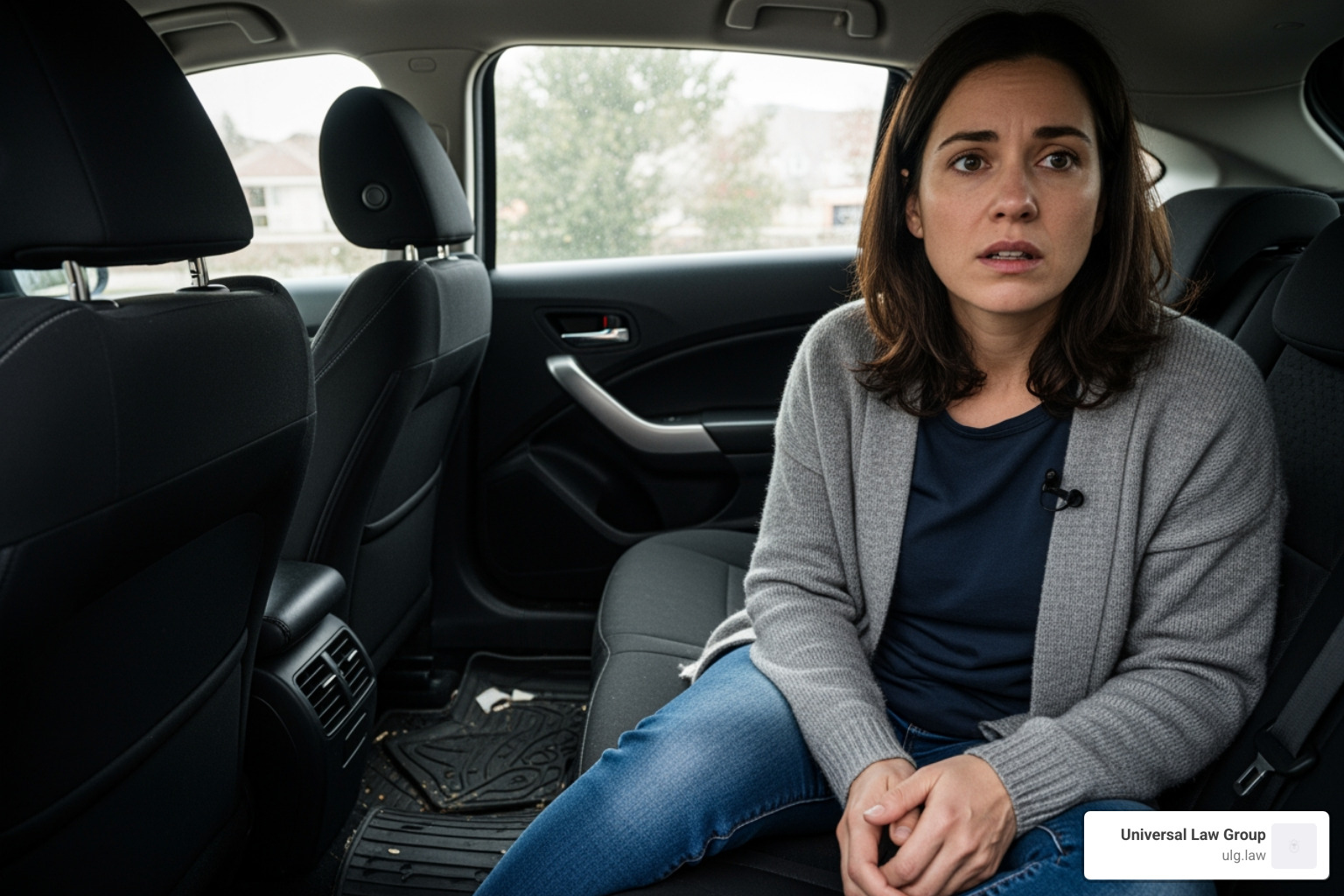
What to Do If Your Uber Crashes: A 2026 Guide
What to do if your Uber crashes can feel overwhelming, but the steps are straightforward: ensure everyone’s safety first, call 911, document everything at the scene, exchange information with all parties involved, report the accident to Uber through their app, and seek immediate medical attention even if you feel fine. After addressing these immediate concerns, contact an experienced rideshare accident attorney to protect your legal rights and steer the complex insurance claims process.
Rideshare services like Uber have revolutionized how we get around. But when your routine Uber ride is suddenly interrupted by the jarring reality of a car crash, the stress and confusion can be paralyzing—especially when you’re not the one behind the wheel.
The reality is that Uber accidents involve multiple insurance policies, complex liability questions, and sophisticated claims adjusters whose job is to minimize what they pay out. Whether you’re an injured passenger, a driver who was hit, or someone dealing with property damage, you need to understand your rights and the specific steps that protect them.
The attorneys at Universal Law Group have spent nearly two decades helping accident victims steer these exact situations. Our firm has successfully handled countless rideshare accident cases, working to ensure injured passengers pursue the full compensation available under Uber’s million-dollar insurance policies.

First Steps at the Scene: Your Immediate Priority List
The moments immediately following a car crash can be chaotic. Your first priority is always safety. Even if you feel fine, adrenaline can mask pain, so it’s crucial to proceed with caution. First, take a deep breath and assess your own condition. Then, check on your Uber driver, other passengers, and occupants of other vehicles. If anyone appears injured or if there’s significant vehicle damage, call 911 immediately. This ensures that police and paramedics are dispatched. The police will create an official report, and paramedics can assess injuries, even those not immediately obvious. If it’s safe, move the vehicles to the side of the road and turn on hazard lights.
What to Say (and Not Say) After the Crash
After an Uber crash, emotions run high. While it’s important to cooperate with the police, anything you say can be used by insurance companies to minimize your claim.
- Stick to the facts: When speaking with police, provide only factual information. Avoid speculation, guessing, or assigning blame.
- Avoid admitting fault: Never apologize for the accident. An apology can be misconstrued as an admission of guilt by insurance adjusters.
- Be cautious with insurance adjusters: If an adjuster from the at-fault party contacts you, remember they are not on your side. Their goal is to settle for the lowest amount possible. It’s best to politely decline to give a recorded statement until you’ve spoken with a lawyer. We can handle all communication with insurance companies on your behalf.
Documenting the Scene: Your Phone is Your Best Tool
Your smartphone is an invaluable tool for gathering evidence. The more you can gather at the scene, the stronger your case will be. Take as many photos and videos as you can from various angles.

Here’s what to focus on:
- Vehicle positions: Capture the final resting positions of all vehicles before they are moved.
- Property damage: Photograph damage to all vehicles and any surrounding property like guardrails or signs.
- Skid marks: These can indicate vehicle speed and braking.
- Traffic signals and road conditions: Document traffic lights, stop signs, and any relevant conditions like potholes or weather.
- Visible injuries: Take photos of any cuts, bruises, or scrapes.
- Overall scene: Take wide-angle photos and videos to show the general layout of the accident scene.
This documentation provides crucial evidence for police reports and insurance claims.
Reporting the Crash and Gathering Critical Information
Once you’ve addressed immediate safety concerns and documented the scene, the next crucial step is to officially report the crash and gather all necessary information. This stage is about collecting the data that will form the backbone of your claim.
Filing a Police Report and Its Importance
A police report is an official record of the accident and is often considered “pure gold” by insurance companies. In Texas, officers are required to file a CR-3 Peace Officer’s Crash Report if an accident results in injury, death, or property damage exceeding $1,000. If police are not called to a minor accident, drivers must file a CR-2 Blue Form themselves within 10 days.
We advise clients to get the police report number from the responding officer, along with their name and badge number. This report provides a factual record of the incident and is critical for your insurance claim.
To get a copy of your Texas accident report:
- Visit the records division of the responding police department.
- Request it online through the TxDOT Crash Report Online Purchase System.
- Have your insurance company or attorney obtain it.
If you hire us, we will handle obtaining the report for you. Most Texas police departments take 7 to 10 business days to file a report. Review it carefully for errors and contact the officer to request an amendment if you find any.
What to do if your Uber crashes: A Passenger’s Checklist
As a passenger, you’re generally not considered at fault, which simplifies your claim process. However, you still need to be proactive in gathering information to protect your interests.
Here’s a checklist of information to collect:
- Uber driver’s information: Full name, phone number, and a photo of their driver’s license and insurance card.
- Other driver’s information (if applicable): Full name, phone number, and photos of their driver’s license and insurance card.
- Witness contact information: If anyone saw the accident, get their names and phone numbers.
- Screenshot of your Uber trip details: This is incredibly important! Before the app resets, take a screenshot showing the driver’s name and photo, vehicle make/model and license plate, route, and trip ID.
How to Report the Accident to Uber
Reporting the accident to Uber is a critical step. As a rider, the easiest way is through the Uber app:
- Go to the “Activity” section and find the trip.
- Select the trip and look for the “Help” or “Safety” option to find the accident reporting feature.
For drivers, they should report it via the Driver app’s Safety Toolkit. Once you report the accident, Uber will reach out to confirm everyone is okay and gather information.
Understanding Uber’s Insurance and Who Is Liable
One of the most confusing aspects of a rideshare accident is navigating the layers of insurance and determining liability. Uber’s business model, which treats drivers as independent contractors, creates a complex insurance landscape. However, Uber maintains significant commercial auto insurance to protect passengers.
How Uber’s Insurance Coverage Works
Uber’s insurance coverage changes based on the driver’s status at the time of the accident. This “tiered” system is crucial to understanding your potential for compensation. While amounts can vary, the general structure in the US follows these periods:
| Period | Driver Status | Coverage Type | Typical US Coverage Limits (Example) |
|---|---|---|---|
| Period 0 | App Offline: Driver is not logged into the Uber app and is using their vehicle for personal use. | Driver’s Personal Auto Insurance | Varies by driver’s policy. |
| Period 1 | App On, Waiting for Request: Driver is logged into the Uber app and awaiting a ride request. | Uber’s Limited Contingent Liability Coverage | $50,000 bodily injury per person, $100,000 bodily injury per accident, $25,000 property damage per accident. |
| Periods 2 & 3 | En Route to Pickup & On Trip with Passenger: Driver has accepted a ride request and is either driving to pick up the passenger or has the passenger in the vehicle. | Uber’s Full Commercial Auto Insurance | $1,000,000 third-party liability coverage. |
| Additional | Uninsured/Underinsured Motorist (UM/UIM) Coverage | Included in Uber’s full commercial policy (Periods 2 & 3). | Up to $1,000,000, protecting passengers if the at-fault driver has no or insufficient insurance. |
As you can see, when you are a passenger in an Uber (Periods 2 & 3), Uber’s robust $1,000,000 third-party liability coverage kicks in. This provides a substantial source of recovery for injured passengers, covering medical expenses, lost wages, and pain and suffering. It’s also important to note that Uber’s insurance for physical damage to the driver’s vehicle has its own limitations, including a significant deductible (often $2,500), which primarily affects the driver, not the passenger.
Understanding Liability: What to do if your Uber crashes and who is at fault
Determining who is at fault, or “liable,” is essential for pursuing compensation. Several parties could be responsible:
- The Uber Driver: If the driver’s negligence (e.g., distracted driving, speeding) caused the crash, their actions trigger Uber’s commercial insurance policy (if in Period 2 or 3).
- The Other Driver: If another driver caused the accident, their personal auto insurance is the primary source of compensation. If their coverage is insufficient or they are uninsured, Uber’s Uninsured/Underinsured Motorist (UM/UIM) policy would likely provide coverage for you.
- A Third Party: In some cases, other entities could be at fault, such as a municipality responsible for poorly maintained roads or a manufacturer of a defective vehicle part.
- Uber’s Potential Liability (Negligent Hiring): While drivers are independent contractors, Uber itself could be held liable in specific circumstances, such as if we can prove they engaged in negligent hiring (e.g., allowing a driver with a dangerous record to operate on the platform).
Navigating these liability questions is where an attorney’s expertise becomes invaluable. We can investigate the accident and determine the most effective path to pursue compensation. For more detailed information, please visit our page on rideshare accidents.
What to Do If Your Uber Crashes and You’re Injured
Even if you feel fine immediately after an Uber crash, many serious injuries have delayed symptoms. The shock and adrenaline can mask pain from whiplash, other soft tissue injuries, and concussions, which may only appear hours or days later.
The importance of seeking medical attention cannot be overstated. It is vital for your health and creates an official medical record that directly links your injuries to the accident. Without this documentation, insurance companies may argue your injuries were pre-existing or unrelated, making it much harder to recover compensation.
Seek Immediate Medical Attention
Your health is paramount. If you experience any pain or discomfort after a crash, seek medical attention right away.

- Emergency Room vs. Urgent Care: For severe symptoms like head trauma or significant pain, go to the nearest ER. For less severe but concerning symptoms, an urgent care clinic is a good first step.
- Follow-up Appointments: Adhering to your doctor’s recommendations and attending all follow-up appointments is crucial. This aids your recovery and demonstrates to insurers that your injuries are legitimate.
- Proving Injuries are Crash-Related: Every medical visit and diagnosis creates a paper trail. This record is the primary evidence we use to prove your injuries resulted from the crash and fight for compensation. If you’ve suffered a brain injury, we have extensive experience with such cases, and you can find more information on our page about brain injuries.
Documenting Your Injuries and Expenses
Beyond medical treatment, carefully documenting all your injuries and accident-related expenses is key to building a strong claim.
- Medical Bills and Prescription Costs: Keep every bill, receipt, and statement related to your medical care.
- Lost Wages Documentation: Collect pay stubs and a statement from your employer detailing your missed work and lost income.
- Future Medical Cost Estimates: Your doctors can provide estimates for future medical care, a significant component of your claim.
- Pain and Suffering Journal: Keep a detailed journal describing your daily pain levels and how your injuries impact your sleep, mood, and overall quality of life.
Thorough documentation allows us to present a comprehensive picture of your damages. For more information, visit our page on personal injury claims.
Protecting Your Legal Rights and Seeking Fair Compensation
After an Uber crash, you’ll interact with insurance companies whose primary goal is to minimize payouts. They might offer a quick, lowball settlement that doesn’t adequately cover your long-term needs. This is why protecting your legal rights is so crucial. In Texas, there’s a strict two-year statute of limitations for filing a personal injury lawsuit. Missing this deadline can result in losing your right to pursue compensation forever.
When to Contact a Rideshare Accident Lawyer
The best time to contact a rideshare accident lawyer is as soon as possible after the incident, once you’ve sought medical attention. Our Houston car accident lawyers can protect your rights from the start.
Consider reaching out to us immediately if:
- Your injuries are significant: If you’ve suffered more than minor scrapes, or if you have delayed symptoms, legal counsel is essential.
- Liability is disputed: If there’s disagreement about who caused the accident, we can investigate and prove fault.
- Before talking to insurance adjusters: We can handle all communication, protecting you from common insurance tactics designed to weaken your claim.
- You receive a settlement offer: Never accept an offer without an attorney’s review. It’s almost always less than you deserve.
By contacting us early, we can preserve evidence, meet deadlines, and negotiate for the maximum compensation you deserve.
Types of Compensation You Can Pursue
When you’re injured in an Uber crash due to someone else’s negligence, you can pursue compensation for a wide range of damages.
Economic Damages: These are quantifiable financial losses:
- Medical Expenses (Current and Future): This includes ER visits, hospital stays, surgeries, physical therapy, and anticipated long-term care.
- Lost Income and Earning Capacity: Compensation for wages you’ve lost, as well as future income if your ability to work is permanently affected.
- Property Damage: If personal items in the Uber were damaged, this can be included.
Non-Economic Damages: These are subjective, non-monetary losses:
- Pain and Suffering: Compensation for the physical pain and emotional distress you endure.
- Emotional Distress: This includes anxiety, depression, or PTSD resulting from the traumatic event.
- Physical Impairment: If your injuries lead to a permanent disability or loss of bodily function.
We have a proven track record of maximizing compensation for our clients in serious accident cases, including truck accidents, which often involve significant damages.
Frequently Asked Questions about Uber Accidents
We understand that you likely have many questions after an Uber crash. Here are some of the most common inquiries we receive:
Can I sue Uber directly if I’m in an accident?
Generally, you cannot directly sue Uber in most accident cases. This is because Uber drivers are classified as independent contractors, not employees, which often shields Uber from direct liability for a driver’s negligence. Instead, if the Uber driver was at fault and on a trip, your claim will be filed against Uber’s commercial auto insurance policy. However, exceptions exist. In rare instances, if we can prove that Uber engaged in negligent hiring (e.g., they knew a driver had a dangerous record), it might be possible to pursue a direct claim against the company. These cases are complex and require experienced legal counsel.
How much is a typical Uber accident settlement?
There’s no “typical” amount for an Uber accident settlement, as each case is unique. The value of your claim depends heavily on the severity of your injuries, your total medical costs (current and future), your lost wages, and the degree of your pain and suffering. The good news is that Uber’s substantial $1,000,000 commercial insurance policy provides a significant source of recovery for seriously injured passengers. This means there’s a strong potential for a substantial settlement that fully covers your damages.
What if the at-fault driver was uninsured?
This is a common concern, but fortunately, if you are a passenger in an Uber, the company’s commercial insurance policy typically includes Uninsured/Underinsured Motorist (UM/UIM) coverage. This is a critical protection. UM/UIM coverage steps in when the at-fault driver either has no car insurance (uninsured) or has insurance, but their policy limits are not high enough to cover your damages (underinsured). In these scenarios, Uber’s UM/UIM coverage acts as a safety net, allowing you to recover compensation for your damages even if the negligent driver can’t pay.
Get the Help You Need After an Uber Crash
Dealing with the aftermath of an Uber crash is incredibly stressful, especially when you’re injured. Knowing what to do if your Uber crashes involves immediate safety measures, thorough documentation, and navigating complex insurance policies. The unique nature of rideshare accidents, with their layered coverages and independent contractor dynamics, makes these claims far more intricate than standard car accidents.
The importance of acting quickly cannot be overstated. Evidence can disappear, memories fade, and the Texas statute of limitations imposes a strict deadline. You don’t have to face these challenges alone.
At Universal Law Group, our experience as a full-service law firm in Houston, TX, means we bring a deep understanding of personal injury law and a proven track record in rideshare accident cases. We leverage our experience to maximize client settlements and aggressively advocate for your rights.
If you or a loved one has been injured in an Uber crash, please don’t hesitate to reach out. We offer free consultations to discuss your case and explain your legal options. Let us handle the complexities so you can focus on your recovery.
Contact our Houston car accident lawyers for a free consultation today.
About the Author

