

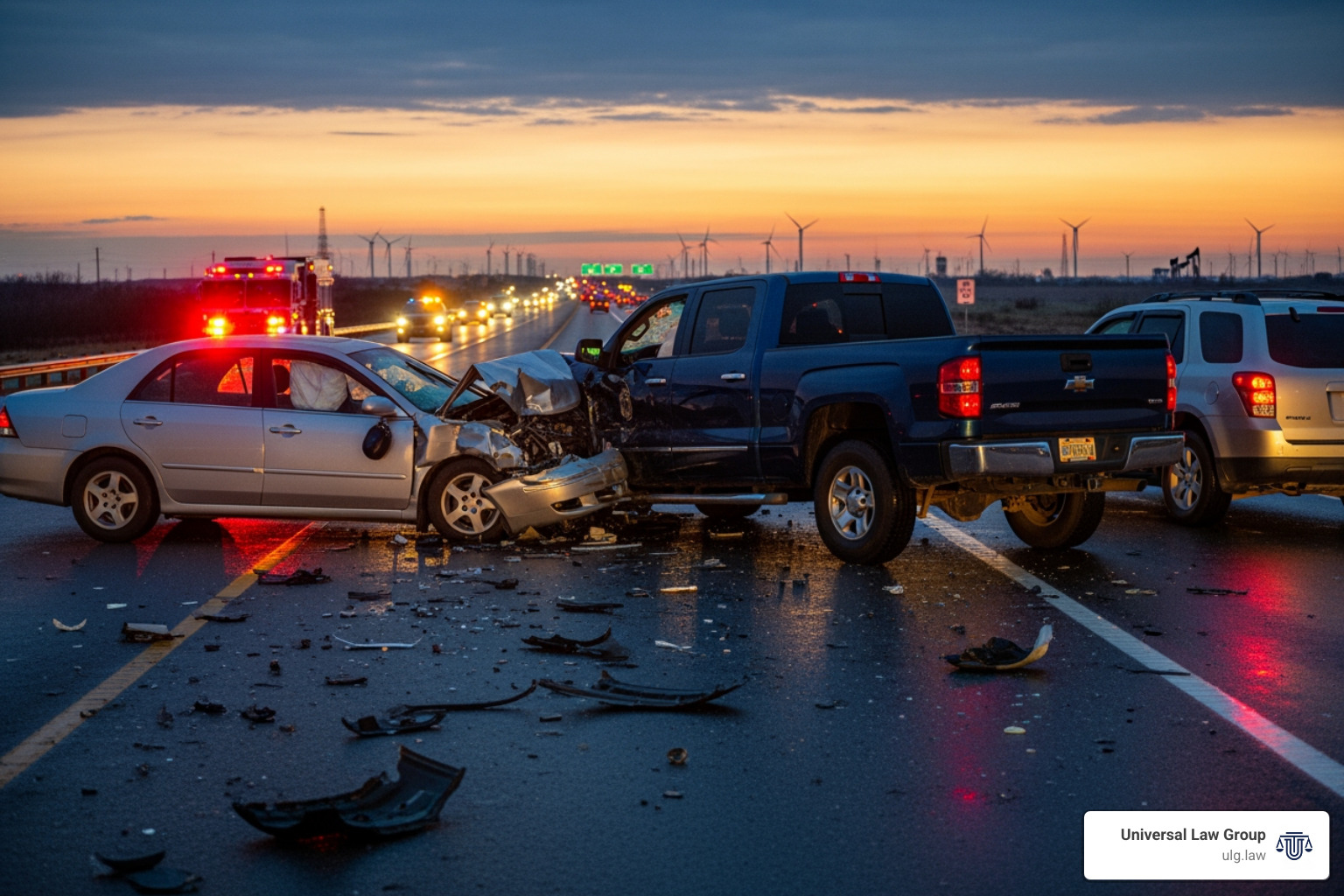
What to Do After a Car Accident in Texas: Ultimate Guide
Why Knowing What to Do After a Car Accident Can Protect Your Rights and Recovery
Knowing what to do after a car accident can feel impossible when you’re shaken and confused. Yet, the moments following a collision are critical for your safety, your legal rights, and your ability to get fair compensation. With over 6 million police-reported crashes in the U.S. in 2023, according to the NHTSA, most drivers will experience an accident in their lifetime. The adrenaline and stress make it hard to think clearly, which is why having a plan is essential.
Here’s what to do after a car accident, step by step:
- Stop immediately and stay at the scene (leaving is illegal under Texas law)
- Check for injuries and call 911 if anyone is hurt
- Move to safety if possible and turn on hazard lights
- Call the police if there are injuries or property damage exceeding $1,000
- Exchange information with all drivers (names, contact details, insurance, license plates)
- Document everything with photos of vehicles, damage, scene, and road conditions
- Get witness contact information if anyone saw what happened
- Never admit fault or apologize at the scene
- Seek medical attention even if you feel fine (some injuries show symptoms later)
- Report the accident to your insurance company and the Texas DMV if required
Whether it’s a minor fender-bender in a Houston parking lot or a serious collision on I-10, the steps you take can significantly impact your recovery for medical bills, lost wages, and vehicle repairs. Missing a crucial step—like failing to document the scene, admitting fault, or delaying medical treatment—can weaken or even destroy your claim.
This guide walks you through exactly what to do after a car accident, covering Texas-specific laws, common pitfalls, and when to contact an attorney. I’m Brian Nguyen, Managing Partner of Universal Law Group. With nearly two decades of experience, from my time as an Assistant District Attorney to leading our personal injury division, I’ve seen how the right actions in the first few hours can make all the difference in a case. Understanding these steps is essential to protecting your health and legal options.

Your Immediate 10-Step Checklist at the Accident Scene
The moments after a car accident are chaotic. Your heart is pounding, and it’s hard to think clearly. That’s why having a plan for what to do after car accident is so important. Following these steps can protect your safety, the well-being of others, and your legal rights.
First, do not leave the scene. Under Texas Transportation Code, Chapter 550, you must stay until police arrive and information is exchanged. Leaving, especially if there are injuries, can lead to serious criminal charges. Prioritize safety, take a deep breath, and work through this checklist.

1. Prioritize Safety and Check for Injuries
After the shock, assess the situation for safety. Adrenaline can mask pain, so be thorough.
- Move to a safe location: If possible, move your car to the shoulder, away from traffic, to prevent further collisions. If your car is disabled, turn on your hazard lights immediately.
- Assess yourself for injuries: Check for any pain, cuts, or discomfort. Even minor aches can signal a more serious issue.
- Check on passengers: Ask everyone in your vehicle if they are hurt, paying close attention to children who may not vocalize their pain.
- Check on others involved: Cautiously approach other vehicles and ask if anyone is injured.
- Do not move seriously injured people: Unless they are in immediate danger (e.g., fire), wait for emergency personnel. Moving someone with a spinal injury could cause permanent harm.
- Call 911 for any injuries: If anyone is hurt, even if it seems minor, call 911 immediately for professional medical assessment.
2. Call the Police and Emergency Services
Calling the police is a crucial step. While not every fender-bender requires a police response, it’s almost always a good idea.
- When to call 911: Always call 911 for injuries, fatalities, or significant property damage. In Texas, you are legally required to report an accident to the police if property damage exceeds $1,000.
- Police report importance: A police report is an official document that is vital for your insurance company to determine fault and process your claim. Even for minor incidents, a report provides valuable documentation.
- Get officer details: Be sure to get the name and badge number of the responding officer(s) and the police report number. This will help you obtain a copy of the official report (CR-3) later.
3. Gather and Exchange Critical Information
This step is fundamental for any insurance claim or legal action. Write everything down or use your phone to record details.
- Information to exchange:
- Full name and contact information (phone, email) of all drivers.
- Driver’s license number.
- License plate number of all vehicles.
- Insurance company name and policy number.
- Vehicle make, model, and color.
- Location, date, and time of the accident.
- Take photos of documents: To avoid errors, use your phone to take clear pictures of the other driver’s license, insurance card, and license plate.
4. Document Everything: What to do after a car accident to build your case
Comprehensive documentation is one of the most powerful tools for your claim. The more evidence you gather, the stronger your case.
- Take photos from multiple angles:
- Vehicle damage: Get detailed shots of damage to all vehicles involved.
- The scene: Capture the overall context, showing vehicle positions, traffic lanes, and the surrounding area.
- Evidence: Photograph skid marks, debris, and any relevant traffic signals or signs.
- Conditions: Document the weather and road conditions (wet, icy, potholes).
- Injuries: If you have visible injuries, photograph them.
- Get witness information: If anyone saw the accident, politely ask for their name and phone number. Independent witnesses provide unbiased accounts that are crucial for determining fault.
- Write down details: While it’s fresh in your mind, jot down notes about how the accident happened. This can be invaluable later when details fade.
5. Never Admit Fault
This is a critical piece of advice. In the emotional aftermath, it’s natural to want to apologize, but this can have severe legal consequences.
- Avoid apologies: Even a simple “I’m sorry” can be misconstrued as an admission of fault by insurance companies or in court, even if you’re just expressing empathy.
- Stick to the facts: When speaking with police or other drivers, state only objective facts. For example, “The other car hit my front bumper.” Do not speculate or assign blame.
- Liability is complex: Determining fault is a legal process. Let police and insurance adjusters do their jobs. Your spontaneous statements can be used as evidence against you.
- Statements can be used against you: Anything you say at the scene can be used by the other party’s insurance company to deny or minimize your claim. It’s best to remain silent on the issue of fault.
For more detailed information on navigating the complexities of accident liability and protecting your rights, we encourage you to visit our page on More info about car accident cases.
After the Scene: Reporting the Accident and Seeking Care
Once the immediate chaos subsides, the next phase of recovery begins. The actions you take in the hours and days following the collision are just as crucial as those at the scene. Timely reporting and medical care can significantly protect your future claim and well-being.
Why You Must Seek Medical Attention
Even if you walk away feeling fine, seeking medical attention is non-negotiable. We’ve seen countless cases where clients who initially felt uninjured developed serious symptoms days or weeks later.
- Adrenaline masking pain: Your body’s “fight or flight” response can temporarily mask pain. Once the adrenaline wears off, the pain from an injury can set in.
- Delayed symptoms: Common injuries like whiplash, concussions, and internal bleeding often have delayed symptoms. Neck pain from whiplash, for example, might not appear for 24-48 hours.
- Documenting injuries for a claim: A gap between the accident and your first medical evaluation can hurt your credibility with insurance companies. They may argue your injuries were caused by something else. Getting checked out immediately creates an official record linking your symptoms to the accident.
- Gaps in treatment hurt your case: Following through with all recommended medical treatment is essential. Insurance companies can use gaps in treatment to argue your injuries weren’t severe. Your health is the priority, and consistent medical records will strengthen any injury claim.
For those concerned about potential head trauma, our page on More info about brain injuries provides valuable insights.
How to Legally Report the Accident in Texas
Beyond calling the police at the scene, you must adhere to specific legal reporting requirements in Texas.
- Texas Transportation Code: The duties of drivers are outlined in the Texas Transportation Code, Chapter 550, Accidents and Accident Reports. This includes stopping, rendering aid, and exchanging information.
- Reporting threshold of $1,000 damage: In Texas, if an accident results in injury, death, or property damage over $1,000 to any one person’s property, you are legally required to report it to law enforcement. This ensures an official police report (CR-3) is generated.
- Filing a Driver’s Crash Report (CR-2 “Blue Form”): If police do not investigate the accident (e.g., for minor damage that later proves more significant), you must file a Driver’s Crash Report (Form CR-2) with the Texas Department of Transportation (TxDOT) within 10 days of the accident. Failure to do so can result in driver’s license suspension.
- Obtaining the official police report (CR-3): You can typically get a copy of the official CR-3 report online through the TxDOT Crash Records Information System (CRIS) or from the investigating law enforcement agency. This report is key evidence for your claim.
What to Do in a Hit-and-Run Accident
A hit-and-run is frustrating, but knowing what to do after car accident in this scenario can make a difference.
- Do not chase the other driver: Your instinct might be to pursue them, but this is dangerous. Prioritize your safety.
- Safely pull over: Move your vehicle to a safe location and turn on your hazard lights.
- Record all details you remember: Immediately write down every detail you can recall about the fleeing vehicle and driver:
- License plate: Even a partial plate is helpful.
- Vehicle description: Make, model, color, and any distinguishing features (dents, stickers).
- Driver description: Gender, approximate age, hair color, etc.
- Direction of travel: Which way did they go?
- Call the police immediately: Report the hit-and-run and provide all the details you’ve gathered. They will file an official police report.
- Check your insurance policy: Review your policy for Uninsured/Underinsured Motorist (UM/UIM) or Collision coverage. UM/UIM can help pay for your damages and medical bills if the at-fault driver isn’t found. Collision coverage typically covers damage to your vehicle regardless of fault.
After the scene, you’ll enter insurance claims. This is where many people feel overwhelmed and where the other party’s insurance company may try to minimize their payout. Knowing what to do after car accident in this phase is crucial for protecting your financial interests.
Reporting the Accident to Your Insurance Company
Notifying your own insurance company is a contractual obligation and a vital step.
- Notify your insurer promptly: Most policies require you to report an accident within a specified timeframe. Delaying could jeopardize your coverage.
- Provide factual information: When speaking with your insurer, be factual and objective, using the notes and photos you collected.
- Avoid speculation: Do not guess about fault or the extent of your injuries. Simply state what happened and that you are seeking medical evaluation.
- Your adjuster vs. theirs: Your insurance adjuster works for you (within your policy’s limits), while the other driver’s adjuster works for their company, aiming to pay as little as possible. We strongly advise against giving a recorded statement to the other driver’s insurance company without legal counsel.
Understanding How an Accident Affects Your Insurance
Many people worry about their insurance rates increasing after an accident.
- Texas is a “fault” state: This means the person who causes the accident is generally responsible for the damages. Unlike in “no-fault” states, fault determination is key in Texas.
- How fault is determined: Insurance companies use police reports, witness statements, and other evidence to determine who was at fault.
- Potential rate increases: If you are found at fault, your rates may increase depending on the accident’s severity and your driving history. If you are not at fault, your rates are less likely to increase.
- Subrogation process: If your insurance pays for your damages but the other driver was at fault, your insurer may seek reimbursement from the at-fault driver’s insurance company through a process called “subrogation.” If successful, you may get your deductible back.
Know Your Rights and When to Contact a Lawyer
Insurance companies are businesses focused on profit, which often means minimizing payouts. This is where knowing your rights and having legal representation becomes invaluable.
- Common insurance company tactics:
- Lowball settlement offers: Insurers often make quick, low offers, hoping you’ll accept before you know the full extent of your injuries.
- Recorded statements: They may pressure you for a recorded statement to use against you.
- Early releases: They might ask you to sign a release that waives your right to future claims.
- Surveillance: Be aware that insurers may monitor your social media or conduct surveillance to dispute your injuries.
- Texas statute of limitations: In Texas, you generally have two years from the date of the accident to file a personal injury lawsuit. While this seems like a long time, building a strong case takes time.
- When to call a lawyer: We strongly recommend contacting a law firm if:
- You or a passenger sustained serious injuries.
- Fault is disputed.
- The accident was a hit-and-run.
- You suspect unfair insurance practices.
- The crash involved a commercial vehicle (like a truck or bus).
- You are dealing with an uninsured or underinsured motorist.
Studies show that claimants represented by a lawyer receive significantly higher settlements on average than those who represent themselves. These statistics underscore the value of legal expertise.
For comprehensive guidance on your legal options after an injury, explore our page on More info about personal injury claims in Houston.
Frequently Asked Questions about What to Do After a Car Accident
We understand you have many questions after an accident. Here, we address some of the most common inquiries about what to do after car accident.
What is considered a minor car accident and do I still need to report it?
A “minor car accident” is typically a low-speed collision with minimal damage and no apparent injuries. However, even in these seemingly minor cases:
- Texas reporting laws apply: If property damage exceeds $1,000 to any person’s property, you are legally required to report it to the police. A seemingly minor scratch can easily exceed this repair cost.
- Reporting is always recommended: It’s wise to exchange information and consider contacting your insurance company. This protects you if the other driver later claims injuries or hidden damage.
How long do I have to file a claim for an injury in Texas?
In Texas, the statute of limitations for personal injury claims is generally two years from the date of the accident. This is the deadline to file a lawsuit.
- Act quickly: While two years seems like a long time, it’s crucial not to delay. Evidence can disappear, witness memories fade, and building a strong case takes time.
- Consult an attorney early: Contacting a lawyer soon after your accident allows them to preserve evidence and ensure all deadlines are met.
What should I do if the accident involves a truck or commercial vehicle?
Accidents involving large commercial trucks are far more complex than standard car accidents.
- Multiple liable parties: Liability can extend beyond the driver to the trucking company, maintenance provider, or cargo loader.
- Federal regulations: Commercial vehicles are subject to strict federal regulations (FMCSA). Violations of these rules can be critical evidence in your case.
- Aggressive defense: Trucking companies carry large insurance policies and their adjusters are very aggressive in defending claims.
- Seek legal advice immediately: Due to the complexity and severe injuries often involved, it is essential to contact an experienced truck accident lawyer right away.
For more information and specialized legal assistance, please refer to our page on More info about truck accidents.
Get the Legal Guidance You Need After a Houston Car Accident
Navigating the aftermath of a car accident is a journey no one should have to take alone. We’ve walked through the essential steps for what to do after car accident, emphasizing immediate safety, thorough documentation, prompt reporting, and critical medical care. These actions are your first line of defense in protecting your well-being and your legal rights.
However, we understand that even with the best intentions, the process can become incredibly complex, especially when dealing with insurance companies, medical bills, lost wages, and the emotional toll of an injury. You don’t have to steer it alone.
At Universal Law Group in Houston, TX, we bring nearly two decades of experience to your side. Our personalized, efficient, and responsive service is designed to guide you through every step, leveraging our team’s former prosecutor experience to maximize your potential settlement. We’re dedicated to protecting your rights and ensuring you receive the compensation you deserve.
If you’ve been involved in a car accident, don’t delay. The sooner you act, the stronger your case can be.
About the Author

