

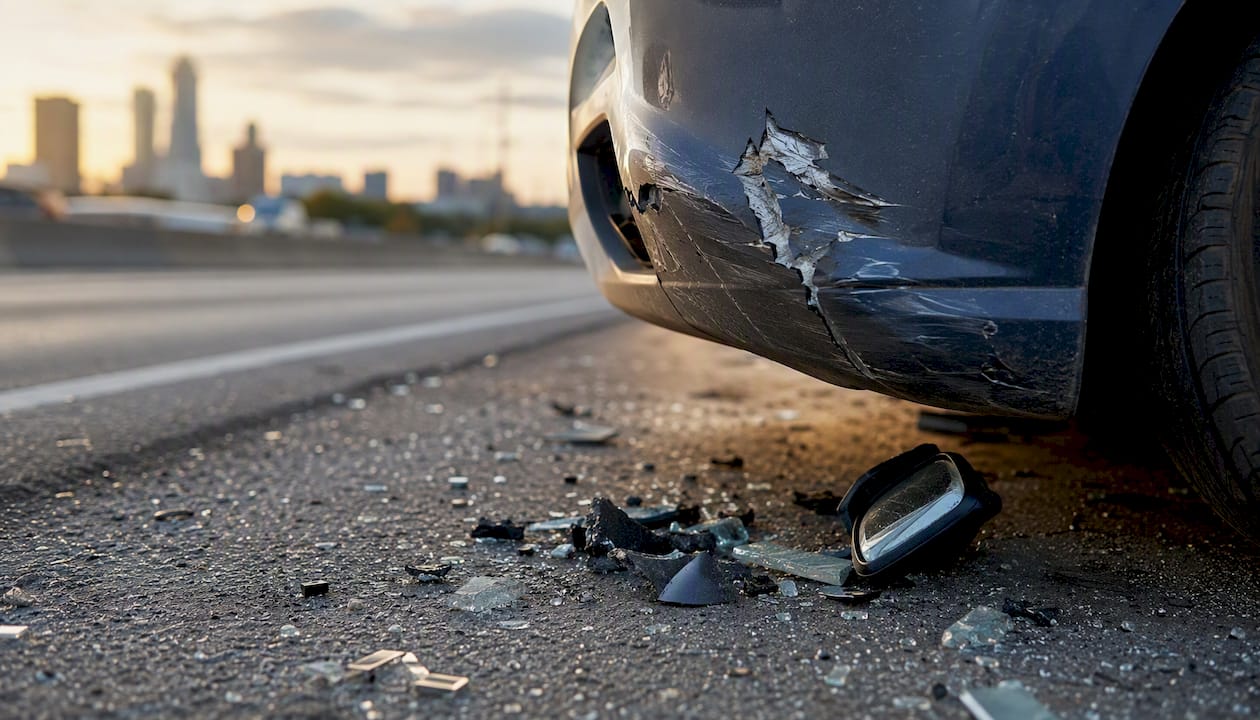
Hit and Run in Texas: Laws, Penalties, and What to Do
Leaving the scene of a collision is a criminal offense under Texas Transportation Code Chapter 550. Whether it rises to a misdemeanor or a felony depends on one thing: the harm caused. Property damage only? You’re looking at a misdemeanor. Serious bodily injury or death? That’s felony territory with years of prison time on the table. Here’s what you need to do right now, whether you were the driver who left or the victim left behind.
If you are the driver:
- Stop immediately and return to the scene if you left
- Call 911 if anyone is injured or a vehicle cannot be driven
- Exchange your name, address, vehicle registration, and insurance information with the other party
- Render reasonable assistance to anyone injured, including arranging transport to a hospital if needed
- Do not admit fault, but do not flee
If you are the victim:
- Call 911 and stay at the scene
- Photograph everything: vehicle damage, skid marks, debris, and the surrounding area
- Collect contact information from any witnesses
- Note the direction the other vehicle traveled, its color, make, and any partial plate numbers
- Request a written police report number before you leave
Key Takeaways
A hit-and-run in Texas can be a misdemeanor or a felony depending on the harm caused, and the statutory duties under Texas Transportation Code Chapter 550 apply to every driver involved in any collision.
| Point | Details |
|---|---|
| Felony thresholds | Serious bodily injury triggers a third-degree felony; death triggers a second-degree felony under TRANSP § 550.021. |
| Misdemeanor damage thresholds | Property damage under $200 is a Class C misdemeanor; $200 or more is a Class B misdemeanor under TRANSP § 550.025. |
| Mandatory duties | Every driver must stop, exchange information, and render reasonable assistance under TRANSP §§ 550.021–550.023. |
| Victim’s first priority | Call 911, photograph the scene, collect witness contacts, and request nearby surveillance footage the same day. |
| Universal Law Group | Handles criminal defense and victim representation for hit-and-run cases in Houston, TX and surrounding areas. |
Table of Contents
- What does Texas law require you to do after a collision?
- How Texas classifies hit-and-run offenses and the penalties attached
- What are the rules when you hit an unattended vehicle or property?
- When and how do you report a collision in Texas?
- What defenses come up most often in Texas hit-and-run cases?
- What should you do if a driver hit you and fled?
- What do real sentencing outcomes look like in Texas?
- When should you contact an attorney after a hit-and-run?
- What I’ve seen practicing in Texas hit-and-run cases
- How Universal Law Group can help after a hit-and-run
- Sources
- FAQ
What does Texas law require you to do after a collision?
Texas law is specific about what every driver must do after a crash, and the duties apply whether the other party is present or not.
Under TRANSP § 550.021, if a collision results in injury or death, the driver must immediately stop at the scene or as close to it as safely possible, then return to the scene. Leaving without complying is what transforms a crash into a criminal offense.
For crashes that cause only vehicle or property damage, TRANSP § 550.022 requires the driver to stop, remain at the scene, and stay until they have fulfilled the duty to exchange information. On metropolitan-area freeways where vehicles are still operable, drivers must move to a designated collision investigation site, a frontage road, or another suitable location before exchanging information. Moving your vehicle off the main lane is required to reduce secondary crashes, but it does not relieve you of any duty to exchange information or render aid once you reach a safe location.
What information must you provide?
TRANSP § 550.023 spells out exactly what you must give the other party when a collision injures or kills a person or damages an attended vehicle:
- Your full name and home address
- Your vehicle registration number
- The name of your motor vehicle liability insurer
- Your driver’s license, upon request
- Reasonable assistance to any injured person, including arranging transport to a hospital when treatment is apparently necessary or when the injured person requests it
Failing to render that assistance is not a technicality. Legal commentary on § 550.023 makes clear that skipping this duty can escalate your criminal exposure beyond the base hit-and-run charge.
Practical compliance checklist
After any collision, document that you met your statutory duties:
- Take time-stamped photos of both vehicles, the scene, and any visible injuries
- Write down the other driver’s name, plate number, and insurer on the spot
- Get the names and phone numbers of any witnesses
- Keep a copy of any text or written exchange of information
- Note the exact time and location of the crash
Pro Tip: If you are on a Houston freeway and your vehicle is drivable, move to the nearest designated collision investigation site before exchanging information. Stopping in a live lane when you can safely move is itself a citable offense under § 550.022, separate from any hit-and-run charge.
How Texas classifies hit-and-run offenses and the penalties attached
The severity of a leaving-the-scene charge in Texas tracks directly to the harm caused. The table below maps each scenario to its offense class, the governing statute, and the typical penalty range.
| Incident Type | Offense Class | Statute | Typical Penalties |
|---|---|---|---|
| Property damage only, under $200 | Class C misdemeanor | TRANSP § 550.025 | Fine up to $100; no jail |
| Property damage only, $200 or more | Class B misdemeanor | TRANSP § 550.025 | possible county jail time and fines |
| Collision causing bodily injury (non-serious) | Class A misdemeanor or third-degree felony | TRANSP § 550.021 | up to 1 year county jail (misdemeanor) or prison terms for felony; fines up to $10,000 |
| Collision causing serious bodily injury | Third-degree felony | TRANSP § 550.021 | 2–10 years prison; fines up to $10,000 |
| Collision causing death | Second-degree felony | TRANSP § 550.021 | 2–20 years prison; fines up to $10,000 |
A few short examples show how quickly the classification shifts:
- A driver clips a parked car in a parking lot, causing $150 in damage, and drives off without leaving a note. That’s a Class C misdemeanor — a fine, no jail.
- The same driver causes $800 in damage to the parked car. Now it’s a Class B misdemeanor, with potential county jail time.
- A driver rear-ends another vehicle on I-10, injures the other driver badly enough to require surgery, and flees. Under § 550.021, that’s a third-degree felony with up to 10 years in prison.
- If the injured driver dies, the charge becomes a second-degree felony, carrying up to 20 years.
Additional charges compound the exposure significantly. A driver who was intoxicated at the time of the crash faces separate DWI or intoxication assault charges on top of the leaving-the-scene count. Intoxication assault causing serious bodily injury is itself a third-degree felony under Texas Penal Code § 49.07, meaning a fleeing intoxicated driver can face multiple felony counts simultaneously.
What are the rules when you hit an unattended vehicle or property?
Hitting a parked car or a fence when no one is around does not eliminate your legal duties. Texas law still requires you to act.
Under TRANSP § 550.024, if you strike an unattended vehicle, you must make a reasonable effort to locate the owner. If you cannot find the owner, you must leave a written notice in a conspicuous place on or in the damaged vehicle. Under TRANSP § 550.025, the same duty applies when you damage a structure, fixture, or landscaping adjacent to a highway.
What the notice must include
- Your full name
- Your home address
- Your vehicle registration number
- A brief description of the circumstances of the collision
The damage thresholds that change the offense class are set out in Chapter 550: damage under $200 is a Class C misdemeanor; damage of $200 or more is a Class B misdemeanor. Those thresholds apply to both unattended vehicles and damaged property or fixtures.
A note template you can use
If you cannot locate the owner, leave a note that reads:
“My name is [Full Name], address [Your Address], registration number [Plate/VIN]. On [Date] at approximately [Time], my vehicle made contact with yours at [Location]. Please contact me at [Phone Number].”
Keep a photo of the note on the vehicle before you leave. That photo, time-stamped on your phone, is evidence that you complied with the statute.
- Do not simply drive away because no one saw the collision
- Do not leave only a phone number without your name and address
- Do not assume that minor cosmetic damage falls below any threshold without measuring or estimating carefully
When and how do you report a collision in Texas?
Reporting is not optional when the crash involves injury, death, or a vehicle that cannot be driven away.

Under TRANSP § 550.026, operators involved in collisions that cause injury, death, or render a vehicle undrivable must immediately notify local police, the county sheriff, or the nearest office of the Texas Department of Public Safety by the quickest available means. “Immediately” means now, not after you get home and think about it.
On the law-enforcement side, TRANSP § 550.062 requires officers to file a written collision report electronically with the Texas Department of Transportation within 10 days when the crash resulted in injury, death, or apparent property damage of at least $1,000. That officer report is the document prosecutors use to file charges and the document victims use to support insurance and civil claims. Getting a police report number at the scene is not a formality — it is the foundation of every legal action that follows.
What investigators typically do next
Once officers arrive and a report is triggered, the investigation moves quickly:
- Officers document the scene with photographs, measurements, and written notes
- Witnesses are interviewed and their contact information recorded
- Damaged vehicles may be towed and inspected for paint transfer, impact angles, or mechanical evidence
- Officers request video from nearby traffic cameras, business surveillance systems, and dashcams
Video and witness accounts disappear fast. Surveillance footage is often overwritten within 24 to 72 hours. Acting quickly, whether you are a victim requesting footage or a defense attorney preserving evidence, is not just good practice — it can determine whether a case is ever resolved.
Reporting threshold to remember: The $1,000 apparent-damage threshold under § 550.062 triggers the officer’s duty to create a written report. If your damage is close to that line, assume it crosses it and request a report.
What defenses come up most often in Texas hit-and-run cases?
Both drivers facing charges and victims trying to understand what happened need to know how these cases are contested. The defenses below are the ones Texas criminal defense attorneys raise most frequently.
Lack of knowledge. A driver cannot be convicted of leaving the scene if they genuinely did not know a collision occurred. This defense is most plausible in low-speed incidents, highway merges, or cases where the contact was minor and the driver had no reason to believe damage or injury resulted. What undercuts it: dashcam footage showing the driver looking back, witness testimony that the driver slowed and then accelerated, or visible damage to the driver’s own vehicle.
Mistaken identity. Partial plate numbers, poor lighting, and brief witness observations create real identification problems for prosecutors. Defense attorneys frequently rely on server logs, traffic-cam timestamps, and cell-tower records to challenge the state’s identification evidence. If the prosecution’s case rests on a single witness who saw a “dark blue sedan,” that is a thin foundation for a felony conviction.
Private-lot exclusions. Chapter 550 applies to collisions on public roads and highways. Crashes that occur entirely on private property, such as a parking garage or a private driveway, may fall outside the statute’s reach, though Texas courts have interpreted “highway” broadly and this defense has limits.
Necessity or emergency. A driver who left the scene to rush an injured passenger to the hospital may raise a necessity defense. The key is that the driver must have reported the collision as soon as the emergency allowed. Silence after the fact defeats this defense.
Third-party interference. In rare cases, a driver argues that a passenger or third party prevented them from stopping. This defense requires credible corroborating evidence and rarely succeeds on its own.
On the procedural side, preserve everything. If you are contacted by law enforcement as a suspect, you have the right to remain silent and the right to counsel. Invoking those rights immediately, before answering questions, is not an admission of guilt. It is the single most important procedural step you can take.

What should you do if a driver hit you and fled?
If you are the victim of a hit-and-run collision, the actions you take in the first hour matter more than almost anything that comes later.
Step-by-step checklist for victims
- Call 911 immediately. Report the collision, your location, and any injuries. Request an officer at the scene even if your injuries seem minor.
- Photograph everything. Capture your vehicle damage, the road surface, skid marks, debris, and the surrounding area from multiple angles.
- Note the fleeing vehicle’s details. Color, make, model, direction of travel, partial plate, and any distinguishing features — write them down or record a voice memo before the details fade.
- Collect witness contacts. Get names and phone numbers from anyone who saw the collision or the fleeing vehicle.
- Request nearby camera footage. Ask businesses, gas stations, and restaurants near the scene to preserve their surveillance video. Do this the same day — footage is often overwritten within 24 to 72 hours.
- Get a police report number. Do not leave the scene without confirming an officer has filed or will file a report. That report number is required for your insurance claim.
- Seek medical attention promptly. Even if you feel fine, get evaluated. Delayed-onset injuries are common after crashes, and a gap in medical records can hurt a later claim.
- Notify your insurer the same day. Report the collision even before the other driver is identified.
How uninsured motorist coverage works here
When the fleeing driver is never identified, uninsured motorist (UM) coverage is often the most practical avenue for compensation. Texas law allows you to make a UM claim against your own policy when the at-fault driver cannot be found, provided you have that coverage. Prompt police reports and medical records materially strengthen UM claims. Tell your adjuster exactly what happened, provide the police report number, and submit your photos and witness information as soon as possible.
Pro Tip: Do not give a recorded statement to any insurer, including your own, before speaking with an attorney if your injuries are significant. Adjusters are trained to ask questions that can limit your recovery, and you are not required to give a recorded statement immediately.
What do real sentencing outcomes look like in Texas?
Understanding the statutory ranges is useful, but knowing how cases actually resolve gives you a more honest picture of what you or someone you know may face.
Property-damage-only cases rarely result in jail time for first-time offenders. A Class B misdemeanor for a $200-or-more damage hit-and-run often resolves through a fine, community service, or deferred adjudication — a form of probation that, if completed successfully, avoids a final conviction on the record.
Cases involving bodily injury are treated far more seriously. A third-degree felony plea for leaving the scene after causing serious bodily injury typically carries probation with conditions, but trial exposure includes prison terms. Prosecutors in larger Texas counties, including Harris County, have pursued active prison sentences in cases with egregious facts, such as leaving an injured pedestrian in the road.
Death cases are second-degree felonies with significant prison terms. Plea agreements in these cases often still involve significant prison time, particularly when the driver was intoxicated or when the victim was a pedestrian or cyclist.
Collateral consequences that follow a conviction
Beyond the sentence itself, a hit-and-run conviction carries consequences that persist long after any jail or prison term ends:
- Driver’s license suspension or revocation by the Texas Department of Public Safety
- Substantially increased auto insurance premiums, often for years
- Restitution orders requiring payment to victims for medical expenses, lost wages, and property damage
- A permanent criminal record that appears on background checks and can affect employment, professional licensing, and housing applications
- Immigration consequences for non-citizens, including potential deportation for felony convictions
When DWI or intoxication assault charges are added to a leaving-the-scene charge, the combined sentencing exposure increases sharply. A driver facing both a second-degree felony hit-and-run and a DWI with serious bodily injury is looking at multiple felony counts, each carrying independent prison ranges.
When should you contact an attorney after a hit-and-run?
The honest answer is: sooner than you think you need to.
For drivers, contact an attorney the moment you believe you may be a suspect, even before charges are filed. If law enforcement has contacted you, if you know your vehicle was involved in a collision you left, or if you have received a letter or visit from investigators, you need counsel before you say anything to anyone. The same applies if you were involved in a crash and are uncertain whether you fully complied with your duties.
For victims, contact an attorney if your injuries required medical treatment, if the other driver has not been identified, if your insurer is delaying or disputing your UM claim, or if the property damage is significant enough to affect your finances.
What to bring to your first consultation
- Photos from the scene and of your vehicle
- Your police report number (or a copy of the report if available)
- Your insurance policy information and any correspondence from your insurer
- Contact information for any witnesses
- Medical records or bills if you sought treatment
- Any communications you have received from law enforcement
What an attorney does next
After reviewing your situation, a criminal defense attorney will typically investigate the state’s evidence, identify any procedural issues with the stop or investigation, and advise you on whether to cooperate with law enforcement or invoke your rights. For victims, an attorney will pursue the UM claim, coordinate with law enforcement on the criminal investigation, and evaluate whether a civil lawsuit is viable once the driver is identified. Timelines vary, but early involvement consistently produces better outcomes than waiting until charges are formally filed or a claim is denied.
For legal help in Houston and the surrounding area, the attorneys at Universal Law Group handle both criminal defense and victim representation in hit-and-run cases.
What I’ve seen practicing in Texas hit-and-run cases
Most people who contact us after a hit-and-run, on either side of the collision, share one thing: they waited too long. Drivers who left the scene and then panicked for days before calling an attorney often find that investigators have already built a case against them from surveillance footage that would have been harder to obtain a week later. Victims who assumed their insurer would handle everything discover months later that a missing police report or a gap in medical records has gutted their UM claim.
What I find consistently underestimated is how much the classification of “serious bodily injury” matters. Texas courts have defined serious bodily injury as injury that creates a substantial risk of death, causes permanent disfigurement, or results in protracted loss of a bodily function. That definition is broader than most people expect. A broken arm with surgical repair can qualify. A traumatic brain injury almost certainly does. The difference between a Class A misdemeanor and a third-degree felony can turn on a single medical record, which is exactly why early legal involvement, before charges are filed or before a claim is denied, changes outcomes in ways that later intervention simply cannot replicate.
How Universal Law Group can help after a hit-and-run
When you are facing a hit-and-run charge or trying to recover as a victim, the gap between knowing what the law says and knowing what to do next is where cases are won or lost. Universal Law Group represents clients on both sides of these cases in Houston and the surrounding area, providing the kind of direct, practical counsel that moves things forward rather than adding confusion.

Our attorneys handle criminal defense for drivers facing misdemeanor and felony leaving-the-scene charges, victim representation for injury and property-damage claims, uninsured motorist claim disputes, evidence preservation and video or witness statement coordination, and insurance negotiation when adjusters push back on legitimate claims. An initial case assessment covers your specific facts, your exposure or recovery options, and the next concrete steps.
Contact Universal Law Group to schedule your consultation. The sooner you call, the more options you have.
Sources
The primary legal authority for hit-and-run offenses in Texas is Texas Transportation Code Chapter 550, which contains all duties after collisions, offense classifications, and damage thresholds. The full chapter is available in HTML and PDF format on the Texas Legislature’s official statutes site.
Key individual sections to read:
- Texas Transportation Code – Chapter 550 (official statutes page)
For collision report forms and filing procedures, contact the Texas Department of Transportation directly or ask the responding officer for the CR-3 crash report form number. The Texas DPS also maintains guidance on license suspension procedures following criminal traffic convictions.
This article provides general legal information about Texas hit-and-run laws and is not a substitute for advice from a licensed attorney about your specific situation. Confirm current statutes and procedures with the official sources above or a qualified Texas attorney.
FAQ
What is the sentence for a hit-and-run in Texas?
Sentences range from a fine with no jail time for minor property damage (Class C misdemeanor) up to 2–20 years in prison for a collision causing death (second-degree felony) under TRANSP § 550.021. The exact outcome depends on the harm caused, the driver’s criminal history, and whether additional charges such as DWI apply.
Is a hit-and-run considered a felony in Texas?
It can be. Leaving the scene after causing serious bodily injury is a third-degree felony, and leaving after causing death is a second-degree felony under TRANSP § 550.021. Property-damage-only cases are misdemeanors.
How much jail time applies when a hit-and-run causes a death?
A hit-and-run resulting in death is a second-degree felony in Texas, carrying a prison range of 2–20 years and a fine of up to $10,000 under TRANSP § 550.021.
Is it worth suing after a hit-and-run?
Yes, particularly when the fleeing driver is eventually identified. A civil lawsuit can recover medical expenses, lost wages, pain and suffering, and property damage. When the driver is never found, a UM claim against your own insurer is often the most practical path, and Universal Law Group can help you pursue both options.
Recommended
About the Author

