How Do Lawyers Negotiate Settlements?
What is Settlement Negotiation and Why Does It Matter?
At its core, settlement negotiation is the process of resolving a legal dispute without a judge or jury making the final call. It is a contract—a private agreement where one party agrees to give something (usually money) and the other party agrees to drop their legal claims. But why do we do it? Why not just “see them in court”?
The answer usually comes down to a cold, hard cost-benefit analysis. Litigation is expensive. Between expert witness fees, deposition transcripts, and the sheer amount of billable hours required to prep for a trial, the costs can eat up a significant portion of any potential award. By settling, both sides save a small fortune in administrative and legal overhead.
There is also the “certainty factor.” In a courtroom, anything can happen. A witness might freeze up, or a jury might simply dislike a particular argument. Settlement gives you control. You know exactly what the outcome is because you helped shape it. Furthermore, settlements are private. While court records are generally public, a settlement agreement often includes a confidentiality clause, keeping your business or personal matters out of the local headlines.
Key Takeaways
- Settlement negotiation is about control and efficiency. It helps both sides avoid the cost, delay, and uncertainty of trial while reaching a private, binding agreement.
- Lawyers maximize settlements through preparation. Strong negotiations start with a trial-ready case file, a detailed demand letter, and clear proof of damages such as medical bills, lost income, and pain and suffering.
- Strategy matters as much as evidence. Lawyers use tools like anchoring, deadlines, and calculated concessions to increase leverage and push the other side toward a stronger offer.
- Texas law can directly affect settlement value. Rules like modified comparative fault, insurance policy limits, and local jury trends can all shape how much a case is worth and how aggressively it should be negotiated.
- If negotiations stall, the case does not stop. Lawyers can use mediation, litigation pressure, and trial readiness to keep leverage high and improve the chances of a favorable settlement.
For many of our clients at Universal Law Group, the emotional toll of a trial is the biggest motivator. Trials can drag on for years, especially if there are appeals. Settling provides a sense of closure and faster compensation, allowing you to move on with your life. You can find more tips on how settlement negotiations work via FindLaw, which highlights how preparation is the bedrock of any successful deal. If you are currently embroiled in a dispute that feels like it’s heading toward a permanent stay in the courthouse, it might be time to consult a civil litigation attorney to see if a middle ground exists.
How Do Lawyers Negotiate Settlements to Maximize Value?
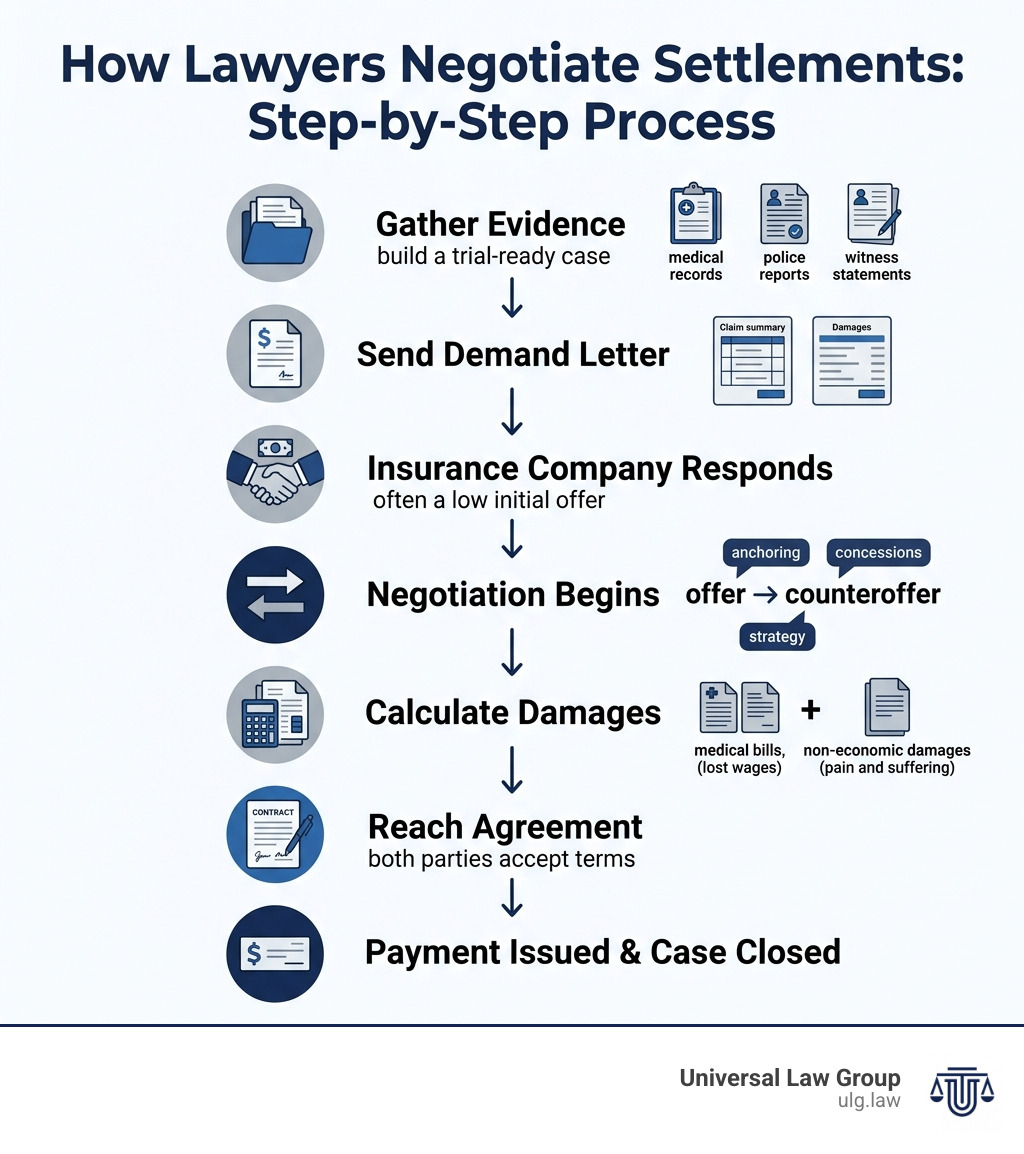
Maximizing a settlement isn’t about being the loudest person in the room; it’s about being the most prepared. We start by building a “trial-ready” file. Even if we have no intention of stepping into a courtroom, we act like we do. This means gathering every medical record, every police report, and every witness statement from day one. When the opposing side sees that we have a bulletproof case, their incentive to settle fairly goes through the roof.
One of the most critical tools in this process is the demand letter. This isn’t just a polite request for money; it’s a legal roadmap. It outlines exactly what happened, why the other party is at fault, and provides a detailed itemization of damages. For those interested in the technical side, the American Bar Association provides a great breakdown on how to draft effective settlement offers, emphasizing that clarity and tone are just as important as the numbers themselves.
| Factor | Settlement | Trial |
|---|---|---|
| Duration | Weeks to Months | Months to Years |
| Cost | Lower (Less discovery/expert fees) | Higher (Court fees, daily trial costs) |
| Privacy | High (Confidentiality clauses) | Low (Public record) |
| Outcome | Guaranteed/Agreed upon | Unpredictable (Jury/Judge whim) |
| Finality | Immediate (Usually no appeals) | Uncertain (Subject to years of appeals) |
To get the highest value, we look at more than just the current bills. We calculate “economic damages”—things like lost wages, future medical treatments, and rehabilitation costs. Then there are “non-economic damages,” often called pain and suffering. We use multipliers or per diem methods to put a human price on the trauma our clients have endured. Whether it’s a car wreck or a business breach, our personal injury services in Houston focus on ensuring no stone is left unturned.

How do lawyers negotiate settlements using psychological influence?
Believe it or not, a lot of what we do is rooted in behavioral science. We often use a technique called “anchoring.” This involves setting a high but justifiable initial demand. Psychologically, this “anchors” the negotiation around that high number, making the eventual counter-offers seem more reasonable by comparison.
We also lean on the principles of Robert Cialdini, a famous psychologist. For example, the rule of reciprocity suggests that if we make a small concession, the other side feels a psychological “debt” to give us something in return. We might use “scarcity” by setting a firm deadline on an offer—an “exploding offer”—to force the other side to stop stalling.
Leveraging “authority” is another big one. Because we have former prosecutors on our team, insurance adjusters know we aren’t afraid of a fight. That reputation alone often changes the tone of the conversation from dismissive to cooperative. It’s about building rapport and mirroring the other side’s communication style until they feel comfortable enough to bridge the gap. This is especially effective in car accident claims and lawsuits, where adjusters deal with hundreds of files and tend to respond better to lawyers who speak their language.
How do lawyers negotiate settlements in Texas personal injury cases?
Texas has its own set of rules that completely change the “how” and “why” of a negotiation. The most important is Modified Comparative Fault, also known as the 51% bar rule. In Houston, if you are found to be 51% or more responsible for an accident, you get nothing. Zero. If you are 30% responsible, your settlement is reduced by 30%.
When we negotiate, we are constantly fighting over these percentages. We also have to navigate Texas insurance policy limits. Many drivers only carry the state minimum of $30,000 per person. If your injuries are worth $100,000, we have to get creative—looking for Personal Injury Protection (PIP) or Underinsured Motorist (UIM) coverage.
Geography matters, too. Houston juries in Harris County can be different from juries in neighboring Montgomery or Fort Bend counties. We use this “venue shopping” knowledge as leverage. If the insurance company knows a Harris County jury is likely to be sympathetic to a truck accident victim, they are much more likely to pay up before we ever file the lawsuit.

The Mechanics of the Deal: From Demand Letter to Final Signature
The process usually starts with an initial case evaluation. We sit down, look at the facts, and decide on a realistic goal. In family law cases, this might be about property division; in injury cases, it’s about the check. Once we have the evidence, we draft the demand.
Shortly after, the insurance company might send a “reservation of rights” letter. Don’t panic—this is just them saying they are investigating the claim but aren’t admitting they have to pay yet. Then the “dance” begins. They offer $10,000; we counter with $80,000. They go to $25,000; we go to $70,000.
Throughout this cycle, we maintain “settlement authority,” meaning we never agree to a final number without your explicit “okay.” Once we hit the sweet spot, we move to the paperwork. You’ll sign a “Release of Liability,” which means the case is over forever in exchange for the payment. Depending on the size of the deal, we might discuss a “structured settlement”—where you get paid over time—or a “lump sum.” This is a common path for motorcycle accident victims who may have long-term care needs.
Dealing with Insurance Adjusters and Opposing Counsel
Insurance adjusters have a job: to keep as much of the company’s money as possible. They use “lowball” offers early on, hoping you’re desperate for quick cash. They might also use delay tactics, “losing” paperwork or waiting until the last minute to respond to an email.
Our secret weapon? Former prosecutor leverage. When you’ve spent years in a courtroom handling criminal defense, you develop a very high “BS” detector. We know when an adjuster is bluffing. We also advise our clients to never give a recorded statement without us. Those statements are designed to trip you up and get you to admit fault where there is none.
If an insurance company is being particularly difficult, we might file a “bad faith” claim. In Texas, insurance companies have a legal duty to handle claims fairly. If they don’t, they can be sued for even more than the original policy limit. We also dig deep to uncover hidden assets, especially in catastrophic brain injury cases where the policy limit isn’t enough to cover the lifetime of medical care required.
When Negotiations Stall: Mediation and Litigation
Sometimes, two people just can’t agree. That’s where mediation comes in. A mediator is a neutral third party—often a retired judge or senior lawyer—who sits both sides down (usually in separate rooms) and tries to find a compromise. Mediation is often court-ordered in Houston, and it works remarkably well. It’s private, less formal than a trial, and gives everyone a chance to air their grievances.
If mediation fails, we move toward trial. But even then, the negotiation doesn’t stop. Many cases settle on the “courthouse steps”—literally the morning the trial is supposed to start. The pressure of a looming jury selection has a funny way of making people more reasonable.
Our Houston appellate lawyers are always in the background, ensuring that if we do go to trial, the record is protected for any future appeals. We use trial readiness as our ultimate leverage. If the other side knows we have the resources and the will to go the distance—whether it’s for a car wreck or a dog bite claim—they are much more likely to offer a fair deal.
Frequently Asked Questions about Legal Settlements
How long does it typically take to reach a settlement?
There is no “standard” time, but most straightforward cases resolve in 3 to 9 months. If the injuries are severe and we have to wait for “Maximum Medical Improvement” (to see how you’ll heal long-term), it can take 12 to 18 months. Complex business or family disputes can take longer if there is a lot of “discovery” (document swapping) involved.
Do I really need a lawyer if the insurance company offered me money?
Technically, no. But remember that 91% vs. 51% statistic. Insurance companies are professional negotiators. Going up against them without a lawyer is like trying to play a professional sports team with a group of friends you met at the park. A lawyer almost always nets you a higher amount, even after the legal fees are paid.
What happens if the other side refuses to negotiate in good faith?
We stop talking and start filing. Sometimes the only way to get someone’s attention is to serve them with a formal lawsuit. Once the “discovery” phase begins and they have to start turning over internal emails and documents under oath, their willingness to negotiate usually returns very quickly.
Why Skilled Settlement Negotiation Can Make All the Difference
At Universal Law Group, we don’t just “process” cases; we advocate for people. We understand that behind every settlement negotiation is a family, a business, or an individual trying to get their life back on track. By leveraging our Houston-based expertise and our background as former prosecutors, we provide a level of aggressive, personalized service that big “mill” firms simply can’t match.
If you’re wondering how do lawyers negotiate settlements because you’re currently stuck in a legal stalemate, don’t navigate it alone. Whether it’s a personal injury, a family dispute, or a complex business matter, our team is ready to step in and push for the result you deserve. You can learn more about our civil litigation practice here or contact us today to start the conversation. We’re here to ensure that when you sign that final agreement, it’s on terms that actually work for you.
About the Author