

One Simple Way to Understand 4-Way Stop Rules
Why Understanding Right-of-Way is Critical for Safety
4 way stop rules are simpler than many drivers think, yet confusion at these intersections causes thousands of crashes every year. Here’s the quick answer you need:
Basic 4-Way Stop Rules:
- First to arrive, first to go – The vehicle that reaches the intersection and stops first proceeds first
- Yield to the right – When two vehicles arrive simultaneously, the driver on the left yields to the driver on the right
- Straight traffic has priority – When facing each other, straight-through traffic goes before left-turning traffic
- Pedestrians always come first – Always yield to pedestrians in or entering the crosswalk
According to the National Highway Traffic Safety Administration, over one-quarter of the 36,096 annual traffic fatalities in the United States occur at intersections. The situation is particularly dangerous for young drivers—in Pennsylvania alone, over one-third of crashes involving 16-year-old drivers happened when the teen was pulling out from a stop sign or turning left across traffic.
Here in Texas, where we handle countless intersection-related accident cases, the confusion at 4-way stops often stems from drivers not understanding one simple concept: the law doesn’t grant anyone the “right-of-way”—it only specifies who must yield. This subtle distinction changes everything about how you should approach these intersections.
Many drivers treat 4-way stops like a competition, asserting their perceived right to go first. But the reality is more cooperative than competitive. These intersections require communication, patience, and a defensive driving mindset that prioritizes everyone’s safety over saving a few seconds.
Your Guide to All-Way Stops
The good news? Once you understand the core principles, navigating 4-way stops becomes second nature. Even better, these same principles apply to many other traffic situations you’ll encounter, from merging onto highways to entering parking lots.
I’m Brian Nguyen, Managing Partner at Universal Law Group, and I’ve spent nearly two decades handling traffic accident cases where failure to understand 4 way stop rules led to serious collisions and injuries. As a former Assistant District Attorney who prosecuted countless traffic violations, I’ve seen how a moment of confusion or impatience at an intersection can change lives forever.

The Ultimate Guide to 4-Way Stop Rules
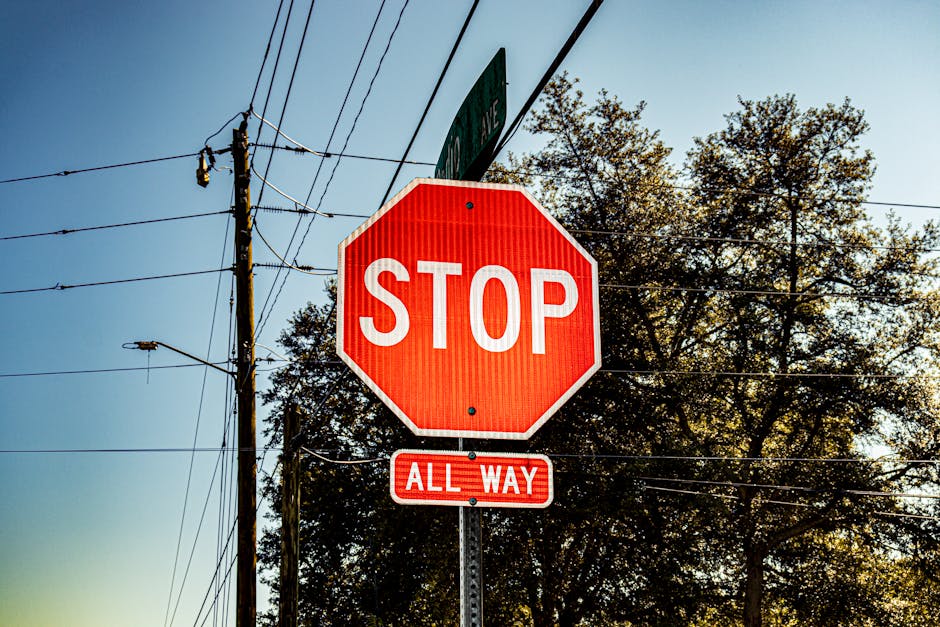
Four-way stops are designed to regulate traffic flow at intersections where traffic signals aren’t necessary or practical. They rely on drivers understanding and consistently applying a few core principles. The sign itself, typically a red octagon with “STOP” in white letters, will often have a smaller “ALL WAY” plaque underneath, clearly indicating that all approaching traffic must come to a complete stop.
When you approach a 4-way stop, your first and most crucial action is to bring your vehicle to a full and complete stop behind the stop line, crosswalk, or before entering the intersection if no line is present. This isn’t a suggestion; it’s a legal requirement. Only after stopping can you begin the process of establishing the order of passage and applying the 4 way stop rules. Our goal at Universal Law Group is to help you cultivate a defensive driving mindset, where safety is always your top priority, especially at these common intersections.
The Fundamental Rule: First to Arrive, First to Go
The simplest and most fundamental of all 4 way stop rules is the “first come, first served” principle. If you arrive at the intersection and bring your vehicle to a complete stop before any other vehicle, you generally have the right to proceed first.
It’s important to stress the “complete stop” part. A rolling stop, often called a “California stop” or “rolling yield,” is illegal and can lead to a traffic ticket and, more importantly, an accident. We’ve seen countless cases in Houston where drivers, eager to save a second or two, fail to stop completely, leading to collisions because they misjudged another driver’s arrival or intention.
After stopping, take a moment to observe the other vehicles. Who stopped before you? Who stopped after? Make eye contact with other drivers if possible to confirm their intentions. Once you’ve established that you were the first to arrive and it’s safe to proceed, you can then move through the intersection. However, even if you have the legal right to go, always ensure the path is clear before proceeding. Asserting your right-of-way when another driver is clearly not yielding can lead to a crash, which is something we always advise against. Your safety is paramount.
When Two Cars Arrive Simultaneously: The “Yield to the Right” Rule
Things get a little more interesting when two or more vehicles arrive at a 4-way stop at approximately the same time. This is where the “yield to the right” rule comes into play. If you and another vehicle reach the intersection and stop simultaneously, the driver on the left must yield the right-of-way to the driver on their right. This rule helps establish a clear order, creating a predictable, clockwise flow of traffic.
For example, imagine you and another car arrive at adjacent corners at the same moment. If that car is to your right, you must wait for them to proceed before you move. Conversely, if you are to the right of another car that arrived simultaneously, you have the right to go first.
This rule is crucial for preventing confusion and potential collisions. It’s a simple, universal principle designed to keep traffic moving safely. Always remember, if there’s any doubt about who arrived first, it’s safer to assume the other driver arrived first or to yield to the right, even if it means waiting a bit longer. Patience is a virtue on the road, especially at busy intersections in Houston.

Head-to-Head Scenarios: Straight vs. Turning Traffic
What happens when two vehicles arrive at a 4-way stop simultaneously, and they are facing each other? This scenario often involves one driver intending to go straight and the other planning to make a turn. In this situation, the primary rule is that straight-through traffic has priority.
If you are going straight and the vehicle opposite you is turning left, the left-turning vehicle must yield to you. This is because a left turn crosses the path of oncoming traffic, which inherently carries more risk. The same principle applies if the opposing vehicle is turning right, though right turns are generally less problematic as they don’t cross oncoming lanes. So, if you’re turning left, you must wait for the straight-through traffic to clear before proceeding.
However, if both opposing vehicles are turning, say one is turning right and the other is turning left, the vehicle turning right typically has priority over the vehicle turning left, as a right turn does not cross the path of oncoming traffic. The Texas Transportation Code, specifically Chapter 545, outlines many of these right-of-way statutes that govern our roads and ensure predictable behavior at intersections.
The “Texas Standoff”: What to Do When Four Cars Arrive at Once
Ah, the dreaded “Texas Standoff” – a moment of collective indecision that can bring a 4-way stop to a grinding halt. This happens when four cars arrive at all four corners of the intersection at virtually the same time. There isn’t one specific traffic law that dictates who goes first in this exact scenario. It’s a true test of communication, courtesy, and defensive driving.
In such a situation, the general rule of “yield to the right” can still be applied, albeit cautiously. Each driver should look to their right to see if another vehicle has the right-of-way over them. However, since everyone arrived simultaneously, this can lead to a perpetual loop of yielding.
This is where the crucial role of driver communication comes in. A friendly wave, a nod, or even a subtle head shake can help break the deadlock. One driver might decide to be the first to yield, signaling to the driver on their right to go, or perhaps signaling for the driver to their left to proceed. While it’s not a legal obligation, we often advise our clients that when in doubt, it’s always safer to let another driver go first. As one expert suggests, “it is recommended to wait for the most aggressive driver to make the first move and then proceed with caution.”
The key is to proceed with extreme caution, making eye contact, and ensuring everyone understands the intended order before any vehicle moves. Never assume the other driver knows what you’re thinking. A moment of patience and clear communication can prevent a potentially serious accident.
Beyond Cars: Right-of-Way for Pedestrians, Cyclists, and Special Vehicles
While our discussion often centers on cars, intersections are shared spaces. Pedestrians, cyclists, and emergency vehicles also have specific rights and responsibilities. Our commitment at Universal Law Group is to ensure all road users understand their role in maintaining safety, especially for the most vulnerable among us.
How pedestrians and cyclists fit into 4-way stop rules
When it comes to 4 way stop rules, pedestrians are generally given the highest priority. In Texas, drivers must yield the right-of-way to pedestrians who are in a marked or unmarked crosswalk. Texas law explicitly states that drivers must exercise due care to avoid colliding with a pedestrian and must give warning by sounding the horn when necessary. Furthermore, drivers must yield to a pedestrian if the pedestrian is on the half of the roadway on which the vehicle is traveling or approaching so closely from the opposite half of the roadway as to be in danger. While some might think pedestrians always have the right-of-way, the law specifies when they must yield too, but drivers always bear a significant responsibility for their safety.
For cyclists, the rules are often similar to those for motor vehicles. In Texas, the law is clear: bicyclists are generally considered vehicles and have the same rights and responsibilities as motorists. As outlined in the Texas Transportation Code, this means at a 4-way stop, a cyclist must come to a complete stop, yield to traffic with the right-of-way, and signal their intention to turn. Drivers should always be vigilant for cyclists, who can be harder to see, and give them the same space and courtesy they would any other vehicle.
Emergency Vehicles: The Ultimate Priority
There’s no debate when it comes to emergency vehicles: they have the ultimate priority. Police cars, fire trucks, and ambulances, when operating with sirens and flashing lights, indicate an urgent situation where every second counts. Your legal and moral duty is clear: yield to them immediately and safely.
If you hear sirens or see flashing lights approaching, even if you’re at a 4-way stop, you must pull over to the right side of the road and stop until the emergency vehicle has passed. If you are already in the intersection when an emergency vehicle approaches, continue through the intersection to clear it, then pull over to the right and stop. Never block an intersection or try to outrun an emergency vehicle. Your quick and proper response can literally save lives.
School Buses: Protecting Our Children
Our children’s safety is non-negotiable, and school bus laws reflect that. When a school bus stops and activates its flashing red lights or extends its stop arm, it means children are getting on or off. All vehicles, both traveling in the same direction as the bus and those traveling in the opposite direction, must stop.
In Texas, this rule applies on any two-lane road, or a multi-lane road if it is not divided by a physical barrier. If the highway is divided by a physical barrier (like a concrete median), only traffic traveling in the same direction as the bus must stop. The penalties for violating school bus stop laws are severe because the consequences of a child being hit are tragic. Always be attentive to school buses and be prepared to stop.
Expanding Your Knowledge: Other Common Right-of-Way Scenarios
Understanding 4 way stop rules is just one piece of the puzzle. The principles of yielding and right-of-way extend to many other common driving situations. By applying the logic you’ve learned, you can become a more confident and safer driver across the board.
Uncontrolled Intersections and T-Intersections
Not all intersections have stop signs or traffic lights. These are known as uncontrolled intersections, and they’re particularly common in residential areas or rural roads around Houston. At an uncontrolled intersection, the fundamental “yield to the right” rule still applies: if two vehicles arrive at the same time, the driver on the left must yield to the driver on the right. If you arrive first, you have the right to proceed, but always with caution.
T-intersections, where one road ends at another, also have specific rules. Generally, the vehicle on the road that ends (the “stem” of the T) must yield to all traffic on the through road. This is often indicated by a yield or stop sign, but even without one, the expectation is that through-traffic has priority. Always slow down and be prepared to stop at these intersections.
When Traffic Lights Go Dark
What happens when technology fails? If you approach an intersection where the traffic lights are not working—perhaps due to a power outage or malfunction—you must treat it as a 4-way stop. This is not just a suggestion; it’s the law in Texas. According to the Texas Transportation Code, drivers facing an inoperative signal must stop as they would for a stop sign.
Once stopped, you then apply the standard 4 way stop rules: the first vehicle to arrive (after the lights went out) proceeds first, and if vehicles arrive simultaneously, the driver on the left yields to the driver on the right. Proceed with extreme caution, making eye contact and ensuring the path is clear before moving.
Roundabouts, Merging, and Entering Roadways
Roundabouts are becoming more common, and while they can seem intimidating, their right-of-way rules are designed to improve safety and traffic flow. The key rule for roundabouts is to yield to any traffic already circulating within the roundabout. Vehicles entering a roundabout must wait for a safe gap before proceeding. Statistics show that the most frequent cause of crashes at roundabouts is drivers who fail to yield before they enter.
Merging onto a highway requires careful attention to right-of-way. Drivers already on the highway have the right-of-way. As a driver merging from a ramp, it is your responsibility to find a safe gap, match the speed of highway traffic, and merge smoothly. The Texas Driver Handbook emphasizes that drivers entering a highway from an entrance ramp must yield the right-of-way to vehicles already on the main road. Highway drivers, though they have the right-of-way, should also be courteous and move over if safe to allow merging traffic space.
Finally, when entering a road from a private driveway, alley, or parking lot, you must always yield to all traffic already on the roadway, including vehicles, pedestrians, and cyclists. This means stopping and waiting until the road is completely clear before proceeding.
Construction Zones
Construction zones are temporary, dynamic environments where normal traffic patterns are altered, and hazards are increased. The rules here are simple: obey all signs, signals, and flaggers. Reduced speed limits are common, and fines for traffic violations are often doubled or even quadrupled in Texas work zones to protect workers and drivers.
Always yield to construction vehicles and equipment, and be prepared for sudden stops or changes in traffic flow. Patience and heightened awareness are your best tools in these areas.
The Legal Aftermath: Penalties for Violating Right-of-Way Laws in Texas
Understanding 4 way stop rules and other right-of-way laws isn’t just about smooth traffic flow; it’s also about avoiding legal consequences. Violating these rules in Houston, TX, can lead to significant penalties, both legally and financially. As personal injury attorneys, we frequently see the devastating impact when drivers fail to yield.
Traffic Tickets and Demerit Points
Failing to yield the right-of-way is a traffic offense under the Texas Transportation Code. This can result in a traffic ticket, which carries fines and court costs. While Texas doesn’t use a traditional “demerit point” system like some other states, traffic violations are recorded on your driving record. Accumulating too many violations can lead to surcharges, suspension of your driver’s license, or significantly higher insurance premiums. Fines for failing to yield can be up to $2,000, and up to $4,000 if serious injuries result from the violation.
Determining Fault in a Car Accident
In Texas, we operate under an “at-fault” insurance system. This means that if you cause an accident, you are generally held financially responsible for the damages and injuries that result. A right-of-way violation is a clear indicator of fault in a collision.
When an accident occurs due to a failure to yield, police reports often document the violation, which can be crucial evidence in determining liability. Insurance companies will use this information to assign fault, and the at-fault driver’s insurance will be responsible for covering the damages. If you’ve been involved in an accident, documenting the scene and obtaining a police report is vital. For more in-depth information, we encourage you to explore our resources on car accidents.
The Impact on Your Car Insurance
Beyond tickets and potential liability for damages, violating right-of-way rules can have a long-lasting impact on your car insurance rates. An at-fault accident or even a significant traffic violation on your record signals to insurance companies that you are a higher risk. This often leads to increased premiums, and you may lose valuable good driver discounts. These higher rates can cost you thousands of dollars over several years, making safe driving not just a matter of safety, but also a smart financial decision.
Frequently Asked Questions about 4-Way Stop Rules
Who goes first at a 4-way stop if two cars arrive at the same time?
If two vehicles arrive at a 4-way stop at the exact same time at adjacent corners, the vehicle to the right has the right-of-way. If two vehicles are facing each other at the same time, and one is going straight while the other is turning left, the car going straight has the right-of-way. The left-turning vehicle must yield.
What is the proper way to handle a 4-way stop when all traffic lights are out?
If traffic lights are out at an intersection, you must treat it as a standard 4-way stop. All drivers approaching the intersection must come to a complete stop. Then, apply the standard 4 way stop rules: the first vehicle to arrive (after the lights went out) proceeds first. If multiple vehicles arrive simultaneously, the driver on the left yields to the driver on the right. Always proceed with extreme caution, making eye contact with other drivers, and ensuring the path is clear before moving.
Do pedestrians always have the right-of-way at a 4-way stop?
In Texas, drivers must yield the right-of-way to pedestrians in a marked or unmarked crosswalk. While pedestrians also have responsibilities, drivers bear a greater duty of care. For safety and to avoid legal liability, it is always the best practice to yield to any pedestrian who is in or entering the intersection, regardless of whether a crosswalk is present. Your horn should only be used as a warning of danger, not to assert your right-of-way over a pedestrian.
Driving Defensively and What to Do After an Accident
Navigating Houston’s busy streets requires a thorough understanding of 4 way stop rules and general right-of-way principles. We’ve covered the core tenets: “first to arrive, first to go,” “yield to the right,” the priority of straight traffic over turning traffic, and the paramount importance of yielding to pedestrians and emergency vehicles. The law doesn’t grant right-of-way, it dictates who must yield. This subtle shift in perspective encourages a more cooperative and safer driving environment.
Prioritizing safety over asserting your perceived right-of-way is the cornerstone of defensive driving. A moment of patience can prevent a lifetime of regret. However, despite your best efforts, accidents can still happen, especially when other drivers fail to follow these crucial rules.
If you or a loved one has been involved in an accident in Houston caused by another driver’s failure to yield, you don’t have to face the aftermath alone. At Universal Law Group, we understand the complexities of traffic laws and the devastating impact of personal injuries. Our team of experienced attorneys is here to protect your rights, guide you through the legal process, and fight for the compensation you deserve.
Don’t let another driver’s mistake leave you with mounting medical bills, lost wages, and emotional distress. If you’ve been injured in an accident, contact our Houston personal injury attorneys for a free consultation today. We’re ready to put our expertise to work for you.
About the Author

