

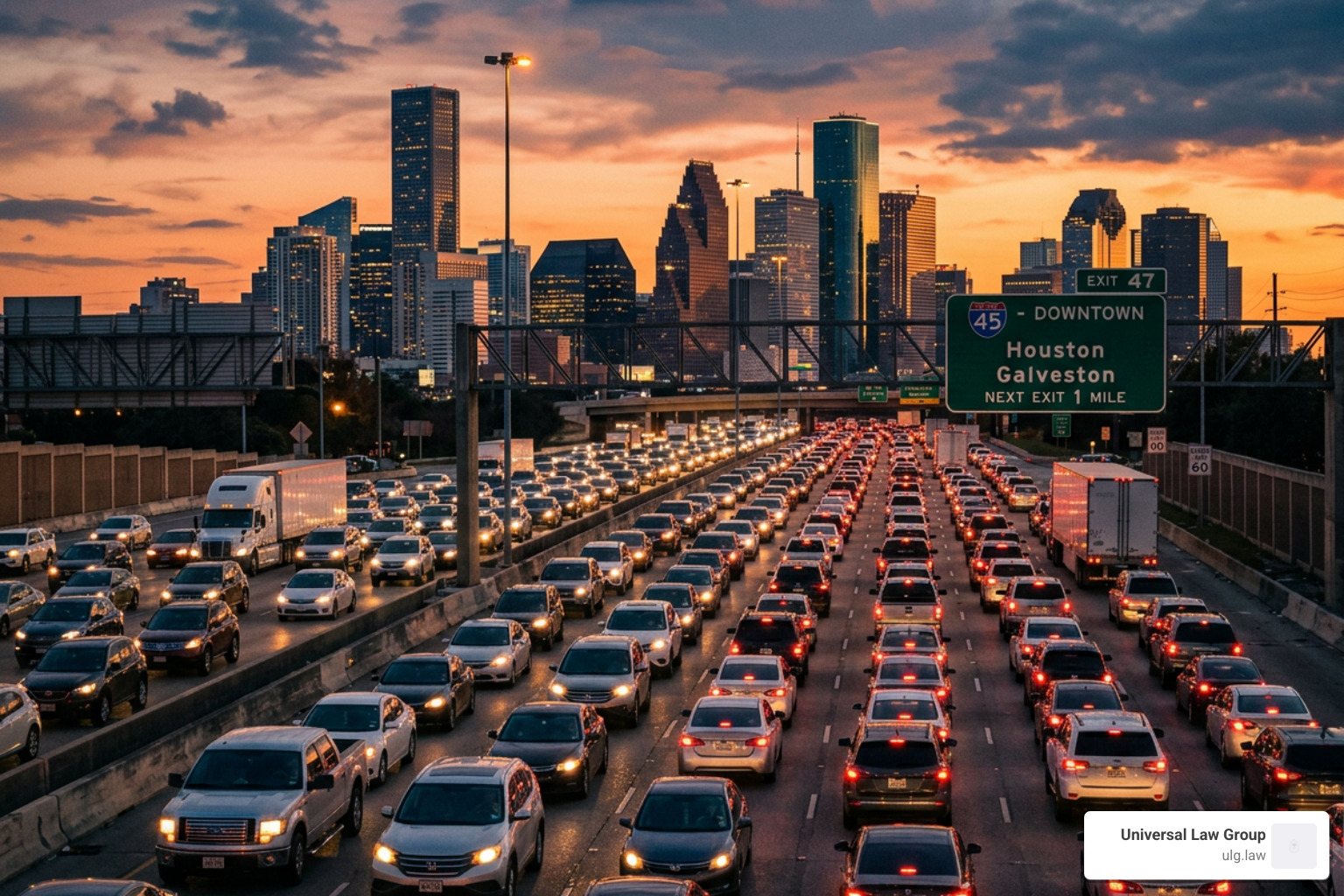
What Are the Most Dangerous Roads in Houston?
Houston Roads Are Deadly — Here’s What You Need to Know
If you’ve lived in Houston for any length of time, you know the feeling. That low-level anxiety that kicks in the moment you merge onto the loop or try to navigate Westheimer during the afternoon rush. It’s not just in your head. The data actually backs up that feeling of dread. Houston’s road network is a sprawling, complex, and—unfortunately—deadly system that claims hundreds of lives every year.
When we talk about the most dangerous roads in Houston, we aren’t just talking about a few potholes or some annoying traffic. We’re talking about stretches of pavement that are statistically some of the most hazardous in the entire United States. If you’re looking for the quick list of where you need to be most careful, here are the top offenders that consistently show up in crash reports:
- I-45 (Gulf Freeway) — Roughly 56.5 fatal accidents per 100 miles; it’s been called the deadliest highway in North America for a reason.
- I-10 (Katy Freeway) — 676 deaths in Harris County over a seven-year span. It’s wide, but that doesn’t make it safe.
- US Highway 59 (Southwest Freeway) — 318 fatal accidents over seven years. The constant construction doesn’t help.
- Westheimer Road — Over 1,200 non-fatal accidents in a single year. It’s the king of the fender-bender.
- Airline Drive — A nightmare for pedestrians and high-volume traffic alike.
- Antoine Drive — Poor visibility and high speeds make this a local hotspot for wrecks.
- Cullen Boulevard — Heavy industrial traffic mixed with residential commuters is a bad combo.
- Beechnut Road — Structural issues and high-frequency intersection crashes.
- Hillcroft Avenue — Dense traffic and some of the most confusing merge points in the city.
- SH-105 — 91 fatalities over seven years; it’s a high-speed route that leaves very little room for error.
Houston’s traffic problem is reaching a breaking point. In 2024, we saw 301 people lose their lives in traffic accidents within the city limits. That is the highest fatality count ever recorded for Houston. Think about that—nearly one person every single day doesn’t make it home. That same year, there were more than 34,500 reported crashes. 2023 was just as chaotic, with 65,931 accidents, making Houston the most accident-prone city in the entire state of Texas.
What’s really wild is how concentrated this danger is. According to 2022 data, just 6% of Houston’s streets account for 60% of all traffic deaths and serious injuries. It’s not the whole city that’s a death trap; it’s these specific corridors where high volume, bad design, and reckless behavior meet.
Key Takeaways
- Avoid the highest-risk corridors when possible — Roads like I-45, I-10, and US-59 consistently report the highest crash and fatality rates in Houston, so plan alternate routes during peak traffic when possible.
- Stay alert on a small group of high-risk streets — About 6% of Houston roads account for roughly 60% of severe crashes, meaning extra caution on corridors like Westheimer, Airline, and Beechnut can significantly reduce your risk.
- Expect danger at major merges and intersections — Locations where high speeds, lane changes, and complex signals meet—such as freeway interchanges and large intersections—are where many serious crashes occur.
- Your driving habits make the biggest difference — Avoid speeding, put the phone away, and leave space around trucks, since speeding, distracted driving, and impaired driving cause a large share of fatal accidents.
- Know your options if a crash happens — After an accident, document the scene, seek medical care, and understand your legal rights, especially if another driver’s negligence caused the collision.
I’m Brian Nguyen, Managing Partner at Universal Law Group. As a former Assistant District Attorney, I’ve seen the aftermath of these statistics from every angle. I’ve handled the legal fallout of crashes on these exact roads, and I know that behind every number is a family whose life has been turned upside down. Understanding where these dangers are—and what to do if you’re caught in one—is something every Houstonian needs to know.

The Deadliest Highways: Why I-45 and I-10 Top the List
If you’ve spent any time on our interstates, you probably have a love-hate relationship with them. Mostly hate, especially when you’re staring at brake lights on a Tuesday at 3:00 PM. But beyond the frustration, there’s a darker reality to these concrete giants. They aren’t just congested; they are genuinely dangerous.
I-45: North America’s Deadliest Highway
It’s not just local hyperbole. I-45 has been statistically crowned the deadliest highway in North America. When you look at the numbers, it’s pretty staggering. The stretch of I-45 that runs through Houston sees about 56.5 fatal accidents for every 100 miles. In one year alone, we saw 73 fatalities on this highway. That’s nearly a quarter of all traffic deaths in the city at that time happening on just one road.
Why is it so bad? It’s a perfect storm of high speeds, heavy congestion, and a “speeding culture” that takes over the second a gap opens up in traffic. The Pasadena stretch is particularly infamous. You’ve got people making sudden lane changes to catch an exit, aggressive merging, and a high rate of intoxicated driving. It’s the kind of road where you can’t afford to blink. You have to be completely dialed in every second you’re behind the wheel.
I-10: The Widest Highway and the “Bottleneck” Illusion
Then there’s the I-10 Katy Freeway. It’s famous for being the widest highway in the world, with some spots reaching 26 lanes. You’d think all that space would make it safer, right? More room to move? Actually, it often does the opposite.
We call it the “bottleneck illusion.” You’re flying along in one of those 26 lanes, and then suddenly, everything has to merge back down or feed into complex interchanges like the 610 Loop or I-45. These merge points are absolute magnets for side-impact collisions and high-speed rear-end accidents. Between 2010 and 2016, Harris County recorded 676 deaths on I-10. Even with the Houston Vision Zero initiative trying to fix things, the sheer volume of over 320,000 vehicles every day makes I-10 a constant hazard.

The High Stakes of Commercial Trucking on I-10
You can’t talk about I-10 without talking about the 18-wheelers. Houston is a massive logistics hub, and our highways are the arteries for the whole country. The Port of Houston sends thousands of trucks onto I-10 every day, carrying everything from oil to Amazon packages.
When a regular car gets into it with an 80,000-pound semi-truck, the car never wins. We see so many truck accidents caused by driver fatigue, shifting cargo, or just the massive blind spots these rigs have. A truck driver who’s been on the road for 11 hours might not see a sedan merging near the Beltway 8 interchange, and that’s how you get a multi-car pileup. If you’re driving near these trucks, give them space. It’s not just about being polite; it’s about staying alive.
Why I-45 Remains a National Outlier
What really sets I-45 apart isn’t just the traffic—it’s the behavior. Harris County consistently has some of the highest drunk driving rates in the country. When you mix alcohol with the high speed limits of the Gulf Freeway, you’re looking at a recipe for disaster.
Complacency is another silent killer. Because we drive these routes every day, we go on autopilot. We check a text, we mess with the radio, or we just stop paying attention to the car three lengths ahead. On I-45, that split second of distraction is all it takes to become another statistic in the next year’s report.
Most Dangerous Roads in Houston: Surface Streets and Local Hotspots
While the highways get the big headlines, Houston’s surface streets are where the everyday chaos happens. These roads don’t have the safety barriers or controlled access of an interstate, which makes them incredibly unpredictable. You’ve got pedestrians, cyclists, delivery trucks, and people just trying to find a parking spot all sharing the same space.
Westheimer Road: The King of Chaos
If I-45 is the deadliest, Westheimer Road is definitely the most chaotic. In a single year, TxDOT data showed 1,228 non-fatal accidents on Westheimer alone. It’s a massive stretch of road that changes personality every few miles—from the high-end shopping of the Galleria to the dense residential neighborhoods further west.
The danger on Westheimer comes from the constant “stop and go.” You’ve got people turning into shopping centers, delivery drivers double-parking, and pedestrians trying to cross where they shouldn’t. It’s a nightmare for rear-end collisions. It’s the kind of road where you have to expect the person in front of you to slam on their brakes for no apparent reason.
Airline Drive and the Pedestrian Risk
Airline Drive is another name that always comes up in the Houston Chronicle’s analysis of dangerous local roads. This road is particularly brutal for people who aren’t in cars. In 2021, pedestrians made up 32% of all traffic fatalities in Houston, even though they only make up about 2% of commuters. Airline Drive, with its heavy commercial traffic and lack of good sidewalks, is a perfect example of where our infrastructure is failing the people who live there.
Other Local Hotspots to Watch
- Bissonnet Street: This one is known for heavy congestion and a lot of accidents near the Westchester Avenue intersection. It’s often school-related traffic, which makes the stakes even higher.
- Beechnut Road: This road has some serious design flaws. The intersections are awkward, visibility is poor, and it leads to a high frequency of crashes that could probably be avoided with better engineering.
- Antoine Drive: High volume and confusing merge points make this a prime spot for side-swipe accidents. People just don’t know where they’re supposed to be.
- Cullen Boulevard: You’ve got a mix of heavy industrial trucks and students or residents. That “push and pull” between big rigs and small cars leads to frequent wrecks.
- US-59 (Southwest Freeway): Even though it’s a highway, the feeder roads and the constant construction near the 610 interchange make it a hotspot. We’ve seen 318 fatal crashes here over a seven-year period.
How to Survive Houston’s Surface Streets
We know you can’t always avoid these roads. Sometimes Westheimer is the only way to get where you’re going. But you can change how you handle it:
- Drive Defensively: Always assume the other driver is about to do something reckless. In Houston, they usually are.
- Put the Phone Away: Distracted driving is the main reason for those 1,200+ accidents on Westheimer. That text isn’t worth a totaled car.
- Double-Check Blind Spots: Especially on roads like Hillcroft or Antoine where people are constantly weaving in and out of lanes.
- Don’t Race the Yellow Light: We’ve all seen people treat a yellow light like a challenge. Don’t do it. T-bone accidents at intersections are some of the most violent and injurious crashes we see.
- Watch for Cyclists: Houston is trying to be more bike-friendly, but the roads weren’t built for it. Give them the three feet of space they’re legally owed. It’s the law, and it saves lives.
The Infrastructure Problem
It’s not always the driver’s fault. Sometimes the road itself is just poorly designed. A lot of Houston’s streets have confusing signs, bad lighting at night, and lanes that are way too narrow for the amount of truck traffic they carry. Our high-speed feeder roads are a uniquely Texan danger. Going from 65 mph on a feeder to a dead stop at a red light requires perfect timing and perfect brakes—and we don’t always have both.
Intersections are where different paths literally collide. In Houston, some of these junctions are designed in ways that feel like they were meant to cause confusion. When you have five or six lanes meeting at odd angles, things are going to go wrong.
The Numbers: Top 5 Intersections
Based on how many crashes happen and how bad they are, these are the spots where you need to be on high alert:
| Intersection | Annual Crash Volume (Approx.) | Primary Danger Factor |
|---|---|---|
| Pease St & Fannin St | 59+ | Complicated signals & one-way speeders |
| Bissonnet St & Westchester Ave | 41+ | School zone congestion & poor yielding |
| Westheimer Rd & Sam Houston Pkwy | High | Massive volume & aggressive turning |
| Main St & South Loop | High | Complex merging & highway transition |
| JFK Blvd & Aldine Bender Rd | High | Airport traffic & tourist confusion |
Pease Street and Fannin Street often take the top spot in studies. Why? Because it’s a convergence of high-speed one-way streets downtown. People are trying to time the lights to get out of the city after work, and they end up running reds or speeding through intersections. This leads to “T-bone” collisions that are incredibly dangerous, even at 30 or 40 mph.
Why Pedestrians are at Risk at Crossings
As we’ve said, pedestrians are at a huge disadvantage here. Most of our dangerous intersections were built for cars first, second, and third. At places like Tidwell and Airline, people have to cross multiple lanes of traffic while drivers are looking at their GPS instead of the crosswalk.
If you want to know more about how these risks affect your legal rights, you can find more info about personal injury in Houston on our site. We see a lot of cases where a driver makes a “right-on-red” without even looking for someone in the crosswalk. Legally, the pedestrian usually has the right of way, but that doesn’t mean much when you’re in the hospital.
The Mecom Fountain and Other Hazards
Then you have the “special” hazards. The Mecom Fountain roundabout at Main and Montrose is beautiful, but it’s a nightmare if you don’t know how to drive it. Roundabouts are still pretty rare in Houston, and the Museum District gets a lot of tourists who have no idea which lane they need. Sudden lane changes in the middle of the circle lead to dozens of side-swipe accidents every year. It’s a classic example of how a beautiful design can be a functional disaster.
Why Houston’s Infrastructure and Driver Behavior Create a Perfect Storm
Houston is kind of a victim of its own success. Our population has exploded over the last twenty years, but the roads haven’t kept up. This creates a “perfect storm” for accidents. We have more people, more cars, and the same amount of space.
Population Growth vs. Road Capacity
When you cram more cars onto the same asphalt, tempers flare. We have people moving here from all over the world, and many of them aren’t used to the “enthusiastic” way Houstonians drive. You get a mix of people driving 10 mph under the limit and people driving 20 mph over. That speed differential is where the danger lives. It leads to frustration, aggressive passing, and eventually, a call to 911.
The Distracted Driving Epidemic
We see it every day. You’re at a light, it turns green, and the car in front of you just sits there because the driver is looking at their lap. Distracted driving is an epidemic in Harris County. Whether it’s texting, checking a map, or eating, taking your eyes off the road for even two seconds at 60 mph means you’ve traveled the length of a football field completely blind. It’s terrifying when you think about it that way.
DUI and Speeding: The Primary Killers
Despite all the PSA campaigns, DUI is still a massive problem here. In 2021, Houston accounted for over 7% of all traffic deaths in Texas. A huge chunk of those involved alcohol or speed. Speeding doesn’t just make an accident more likely; it makes it more deadly. The faster you go, the less time you have to react, and the more force is involved when you hit something. It’s basic physics, but people forget that when they’re in a hurry.
Legal Recourse After an Accident
If you’re in a crash on one of these roads, the aftermath is overwhelming. You’re dealing with injuries, car repairs, and insurance adjusters who are calling you before you’ve even left the hospital.
Here’s the reality: Insurance companies aren’t looking out for you. They want to close your file as quickly and cheaply as possible. That’s why having a legal team is so important. At Universal Law Group, we know the tricks they play because we’ve seen them from the other side.
When we handle a car accident case, we focus on:
- Proving Who Was at Fault: We look at traffic cameras, witness statements, and even accident reconstruction to show exactly what happened.
- Documenting the Scene: Photos of skid marks, road conditions, and vehicle damage are vital evidence that disappears quickly.
- Dealing with Adjusters: We handle all the talking so you don’t accidentally say something that ruins your claim.
- Meeting Deadlines: In Texas, you generally have two years to file a personal injury claim. That sounds like a lot of time, but evidence fades and witnesses move. You have to act fast.
Frequently Asked Questions about Houston Road Safety
What is the single deadliest road in Houston?
If we’re looking at the stats, I-45 (the Gulf Freeway) is the winner, and not in a good way. It has the highest fatality rate per mile in the country. If you’re on I-45, you need to be extra vigilant.
Why are pedestrian accidents going up?
It’s a combination of things. Our city is getting denser, so more people are walking, but our infrastructure is still built for cars. Add in distracted driving and poor lighting at night, and you have a very dangerous environment for anyone not in a vehicle.
What should I do if I’m in a hit-and-run?
First, stay safe. Don’t try to chase the other driver—that just leads to more accidents. Pull over, call the police, and try to remember any details about the car. Look for witnesses or see if any nearby businesses have cameras. Then, call a lawyer. You might be able to file an Uninsured Motorist claim through your own insurance, but it can be tricky to navigate.
Is the Katy Freeway really the widest in the world?
Yes, in certain sections it reaches 26 lanes. But as we’ve seen, more lanes don’t necessarily mean more safety. It often just leads to more complex merging and higher speeds, which can make accidents more severe when they do happen.
How does Houston compare to other Texas cities?
Houston consistently has more accidents than Dallas, San Antonio, or Austin. Part of that is just our size, but part of it is the unique way our highway system is designed with loops and feeders that encourage high-speed merging.
Safer Next Steps After a Houston Crash
Driving in Houston is always going to be a bit of a gamble. It’s a massive, fast-moving city, and the roads reflect that. But knowing where the risks are—whether it’s the 26 lanes of the Katy Freeway or the stop-and-go mess of Westheimer—can help you stay safe. Being aware is your first line of defense.
But even the most careful drivers can’t control what everyone else is doing. If you’ve been hurt on one of the most dangerous roads in Houston, you shouldn’t have to figure everything out on your own. The recovery process is hard enough without having to fight insurance companies at the same time.
At Universal Law Group, we bring a different perspective to your case. We’re a full-service firm with former prosecutor experience, which means we know how to build a case that’s ready for a courtroom from day one. We pride ourselves on being fast and responsive because we know you need your settlement to cover those medical bills and lost wages now, not years down the road. We use our deep understanding of Texas law to make sure you get what you’re actually owed.
Don’t let an insurance company tell you what your recovery is worth. Contact our Houston car accident lawyers today for a consultation. Let us handle the legal side so you can focus on getting back on your feet.
About the Author

