
Cracking the Case: How to Prove Wrongful Death
When Tragedy Strikes: Understanding Your Path to Justice
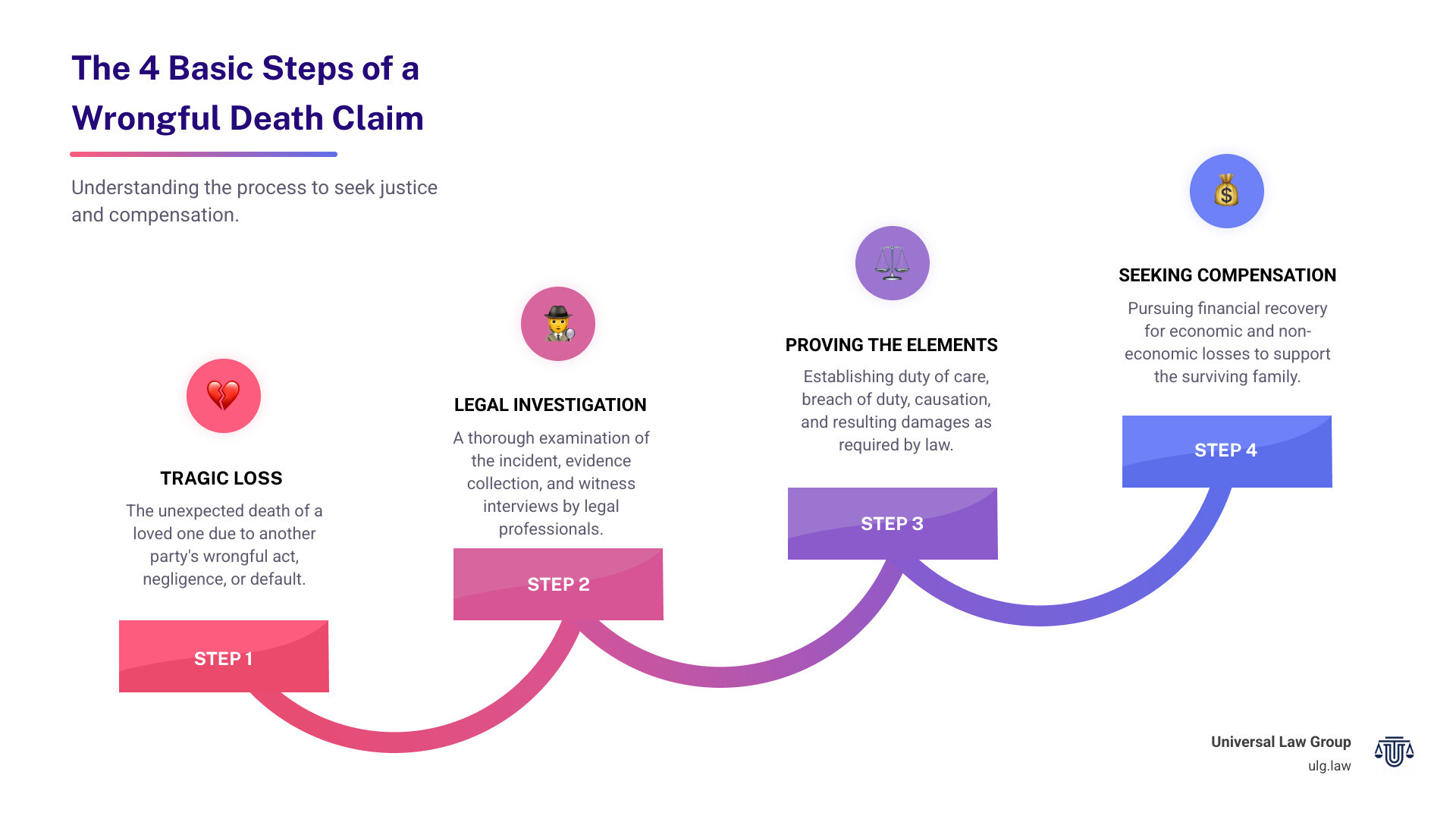
How to prove wrongful death requires demonstrating four essential legal elements in a civil lawsuit. If you’ve lost a loved one due to someone else’s negligence or misconduct, here’s what you must establish to build a successful claim:
- Duty of Care – The defendant owed your loved one a legal responsibility to act with reasonable care.
- Breach of Duty – The defendant failed to meet that standard of care.
- Causation – The defendant’s breach directly caused your loved one’s death.
- Damages – You and your family suffered quantifiable losses as a result.
The sudden loss of a family member is devastating, but when it results from another’s careless or intentional actions, the pain is compounded. Wrongful death is the legal term for when someone dies due to the wrongful act, neglect, or default of another party, such as in a car accident, case of medical malpractice, or workplace incident.
Unlike a criminal homicide case, which punishes the wrongdoer, a wrongful death claim is a civil lawsuit designed to compensate surviving family members. While no amount of money can replace a loved one, these claims hold negligent parties accountable and provide financial stability.
Proving wrongful death demands a methodical legal approach and compelling evidence. The plaintiff (the deceased’s family or estate) must prove the defendant’s negligence or intentional act directly caused the death and resulted in harm. This guide will walk you through the critical elements of building a successful case.
As a wrongful death attorney at Universal Law Group, I’ve spent nearly two decades helping grieving Houston families steer how to prove wrongful death claims. My experience as a former Assistant District Attorney and personal injury lawyer has shown me these cases demand both legal expertise and genuine compassion.
Understanding Wrongful Death: The Legal Foundation
Wrongful death is a specific legal concept referring to a death that occurs due to the negligent, reckless, or intentional actions of another person or entity. If the deceased person could have filed a personal injury lawsuit had they survived, their family may have grounds for a wrongful death claim.
A wide range of incidents can form the basis of a claim, including:
- Negligence: The failure to act with the level of care that an ordinarily prudent person would have exercised. This is the most common basis for these claims.
- Recklessness: A conscious disregard for a substantial and unjustifiable risk that results in harm.
- Intentional Acts: Deliberate actions intended to cause harm, such as assault or other violent crimes.
Common scenarios in Houston that lead to wrongful death claims include fatal car accidents, medical malpractice, and workplace accidents.
It’s crucial to distinguish a wrongful death lawsuit from a criminal homicide case. A wrongful death suit is a civil claim filed by the family to seek financial compensation for their losses. A criminal case is brought by the state to punish the wrongdoer with penalties like imprisonment. The standard of proof is also lower in a civil case, meaning a defendant can be found liable for wrongful death even if acquitted in criminal court.
In Texas, we also handle “survival actions,” which are distinct from wrongful death claims. A wrongful death claim compensates survivors for their losses, while a survival action compensates the deceased’s estate for the pain, suffering, and expenses the deceased endured before death. Our state’s laws have both a wrongful death statute and a survival statute. We can help determine which claims apply to your unique situation.
The Four Pillars: Essential Elements to Prove Wrongful Death
To successfully prove wrongful death, we must establish four fundamental legal elements. Think of these as the four pillars supporting your claim; if one is missing, the structure can collapse.

These four elements are duty of care, breach of duty, causation, and damages. Let’s explore each one.
Element 1: Establishing a Duty of Care
The first step is showing the defendant owed a “duty of care” to the deceased. This is a legal obligation to act reasonably to prevent harm to others. For example, drivers owe a duty to others on the road, and doctors owe a duty to their patients to provide standard medical care. Property owners also owe a duty to keep their premises reasonably safe.
According to the Legal Information Institute (LII), this duty requires someone to behave with the “level of care that someone of ordinary prudence” would have exercised. This “reasonable person” standard helps determine what actions were expected.
Element 2: Proving a Breach of Duty (Negligence)
Once a duty of care is established, we must prove the defendant “breached” that duty by failing to meet the standard of care. This failure is negligence. In simple terms, the defendant acted in a way a reasonable person would not have.
Examples of a breach of duty include:
- For drivers: Distracted driving, speeding, or driving under the influence, which can lead to DWI-related deaths.
- For medical professionals: A surgical error, misdiagnosing a condition, or prescribing the wrong medication.
- For property owners: Failing to fix a known hazard or post warning signs.
- For manufacturers: Selling a defective product without adequate warnings.
Element 3: Linking the Breach to the Death (Causation)
This is often a challenging element. We must establish “causation,” a direct link between the defendant’s breach and your loved one’s death. Their negligence must have been the actual cause of the fatality.
Causation has two components:
- Cause-in-Fact (“But For” Causation): Asks, “But for the defendant’s act, would the death have occurred?” If the answer is no, this is established.
- Proximate Cause (Legal Causation): Focuses on foreseeability. Was the death a reasonably foreseeable result of the defendant’s actions? There must be a direct, unbroken chain of events.
Proving causation is complex, as we must rule out other potential causes. For instance, if someone dies from accidental injuries days after an incident, we must show the initial injury led to the death, often requiring expert medical testimony.
Element 4: Demonstrating Damages
Finally, we must show that your family suffered quantifiable losses, or “damages,” as a direct result of the death. This element transforms the tragedy into a legal claim for compensation, covering both financial and emotional harm suffered by the survivors.
As noted in statutes like North Carolina’s, examples of wrongful death damages include expenses for medical treatment, loss of financial support, and loss of companionship. These form the basis for the compensation we seek to help your family cope.
Building Your Case: Evidence and the Burden of Proof
A strong case is built on compelling evidence and a clear understanding of the legal standard we must meet.

Gathering the Necessary Evidence
The investigation for a wrongful death claim is meticulous. We collect every piece of documentation to paint a clear picture of what happened and who was responsible. Crucial evidence we pursue includes:
- Police and official incident reports
- Autopsy reports and medical records
- Eyewitness statements and depositions
- Photo and video evidence from the scene
- Expert witness analysis and reports
- Financial records showing lost income
- The defective product or other physical evidence
Understanding the Burden of Proof in a Civil Claim
In a wrongful death lawsuit, we don’t need to prove guilt “beyond a reasonable doubt”—that’s the criminal standard. In a civil claim, the burden of proof is a “preponderance of the evidence.”
This means we must convince the judge or jury that it is “more likely than not” (over 50% likely) that the defendant’s actions caused your loved one’s death. This lower standard is why a defendant acquitted in a criminal case can still be found liable in a civil wrongful death suit.
Here’s a quick comparison:
| Feature | Wrongful Death (Civil) | Homicide (Criminal) |
|---|---|---|
| Standard of Proof | Preponderance of the Evidence | Beyond a Reasonable Doubt |
| Who Files Case | Victim’s Family/Estate | The State (Prosecutor) |
| Potential Outcome | Monetary Damages | Prison, Fines, Penalties |
The Role of Expert Witnesses in How to Prove Wrongful Death
Expert witnesses are invaluable for clarifying complex technical, medical, or scientific issues. They help establish standards and connect the defendant’s actions to the death.
Key experts include:
- Medical Examiners/Forensic Pathologists: To confirm the cause of death and link it to the incident.
- Accident Reconstructionists: To recreate accidents and demonstrate how negligence occurred.
- Economists/Vocational Experts: To calculate financial losses like lost future earnings and the value of lost household services.
- Medical Specialists: To testify about the accepted standard of care in malpractice cases and how the defendant deviated from it.
Expert testimony is often pivotal in meeting the “preponderance of the evidence” standard and persuading a jury to rule in your favor.
The legal process for a wrongful death claim can feel overwhelming, especially while grieving. Understanding the procedural rules, Texas-specific laws, and what to expect is critical.
Who Has the Right to File a Lawsuit in Texas?
Not just anyone can file a wrongful death lawsuit. Texas law specifies who has “legal standing.” Under the Texas Wrongful Death Act, the following parties can file a claim:
- The surviving spouse
- The children (including adopted children)
- The parents (including adoptive parents)
If these family members do not file within three months of the death, the estate’s personal representative may file on their behalf. However, the family can request the representative not file. Wrongful death law varies by state, so our focus on Texas law is crucial to ensure your claim is filed correctly.
Recoverable Damages: What Compensation is Available?
A wrongful death lawsuit aims to compensate the family for their profound losses. These “damages” are categorized as economic and non-economic. As legal resources like Nolo explain, wrongful death damages can include a wide range of compensation:
- Economic Damages (quantifiable financial losses):
- Medical Expenses: Costs for the deceased’s final injury or illness.
- Funeral and Burial Costs: The average funeral cost can be substantial.
- Lost Earning Capacity: The income and benefits the deceased would have earned.
- Loss of Inheritance: The value of assets the deceased would have passed on.
- Lost Household Services: The monetary value of services like childcare or home maintenance.
- Non-Economic Damages (intangible losses):
- Mental Anguish: The family’s emotional pain, suffering, and grief.
- Loss of Companionship: The loss of love, comfort, and support.
- Loss of Parental Guidance: For children, the loss of a parent’s nurturing and instruction.
In cases of extreme negligence, Texas law may also allow for Exemplary or Punitive Damages. These are meant to punish the wrongdoer and deter future misconduct. Our experience as former prosecutors helps us pursue these damages when appropriate.
Critical Deadlines: The Texas Statute of Limitations
Time is critical. Every state has a “statute of limitations,” a strict deadline for filing a lawsuit. In Texas, a wrongful death lawsuit must generally be filed within two years from the date of death.
Missing this deadline usually means forfeiting your right to pursue a claim. While rare exceptions exist (like the “findy rule” or “tolling” for minors), they are complex. It is vital to contact an attorney as soon as possible to preserve evidence and meet the deadline.
Overcoming Obstacles: How to Prove Wrongful Death Against Defenses
Even with strong evidence, defendants and their insurance companies will employ various strategies to minimize their liability or deny your claim. Our experience helps us anticipate and counter these tactics to build a resilient case.
Anticipating and Countering Common Defenses
Some common defenses we frequently encounter and counter include:
- Proportionate Responsibility (Comparative Fault) in Texas: Defendants may argue the deceased was partly at fault. Under Texas’s “51% bar rule,” if the deceased is found 51% or more at fault, the family recovers nothing. If they are less than 51% at fault, damages are reduced by their percentage of fault.
- Lack of Causation: Defendants often try to break the causal link, blaming a pre-existing condition or an “intervening cause.” We use expert testimony to establish a clear, direct causal chain.
- Statute of Limitations Defense: If a claim is filed late, the defendant will almost certainly move to dismiss the case, underscoring the importance of acting quickly.
- Assumption of Risk: In some situations, the defense might argue that the deceased knowingly and voluntarily accepted the risks that led to their death.
How a Wrongful Death Attorney Helps Prove Your Case
Navigating these complexities while grieving is an immense burden. An experienced wrongful death attorney from Universal Law Group is essential. Here’s how we assist in proving your case:
- Navigating Legal Complexity: We understand the specific Texas statutes and precedents that apply to your situation.
- Conducting Thorough Investigations: We launch a comprehensive investigation, gathering evidence, interviewing witnesses, and securing expert opinions based on our deep knowledge of tort law.
- Hiring and Managing Expert Witnesses: We have a network of highly qualified experts to provide crucial testimony establishing negligence, causation, and damages.
- Handling Insurance Companies: We manage all communications with insurers, protecting you from tactics designed to devalue or deny your claim.
- Negotiating Settlements: As skilled negotiators, we advocate for a fair settlement. We can also use alternative dispute resolution like Mediation to reach a favorable outcome.
- Representing You in Court: If a fair settlement isn’t reached, our seasoned litigators are prepared to take your case to trial and fight for the justice your family deserves.
Frequently Asked Questions About Proving Wrongful Death
We understand you have many questions during this challenging time. Here are answers to some common questions we receive.
How long does a wrongful death lawsuit take?
The timeline varies significantly. Simple cases may settle in a few months, but complex cases that proceed to trial can take several years. Factors include case complexity, court schedules, and the parties’ willingness to negotiate. We strive for an efficient resolution while ensuring your family receives the full compensation you are entitled to.
Can I file a wrongful death lawsuit if there was also a criminal case?
Yes, absolutely. A civil wrongful death lawsuit is entirely separate from any criminal case. Criminal cases aim to punish the wrongdoer, while civil cases seek to compensate the family. The burden of proof is lower in a civil case (“preponderance of the evidence” vs. “beyond a reasonable doubt”), so you can win a civil claim even if the defendant is acquitted in criminal court.
How much does it cost to hire a wrongful death lawyer?
At Universal Law Group, we handle wrongful death cases on a contingency fee basis. This means you pay no upfront costs or hourly fees. Our payment is contingent on us winning your case. If we don’t recover compensation for you, you owe us nothing. This approach ensures that everyone, regardless of their financial situation, has access to experienced legal representation.
Taking the First Step Toward Justice
Losing a loved one due to another’s negligence is a profound pain. Understanding how to prove wrongful death means navigating a complex legal process: establishing a duty of care, proving a breach, demonstrating causation, and quantifying your family’s damages.
A successful case requires legal knowledge, meticulous investigation, and strategic evidence, including expert testimony. This process demands skill and resources that are difficult to manage while grieving.
At Universal Law Group, we believe grieving families in Houston deserve compassionate and effective legal support. Our team brings nearly two decades of experience, including valuable insights gained from my time as a former prosecutor, to every case. We offer personalized, efficient, and responsive service, committed to building the strongest possible case to secure the financial stability you need.
If you believe your loved one’s death was caused by another party’s negligence or misconduct, please don’t hesitate. Take the first step toward justice and contact us today for a free, no-obligation consultation. Let us put our experience to work for you.
About the Author