

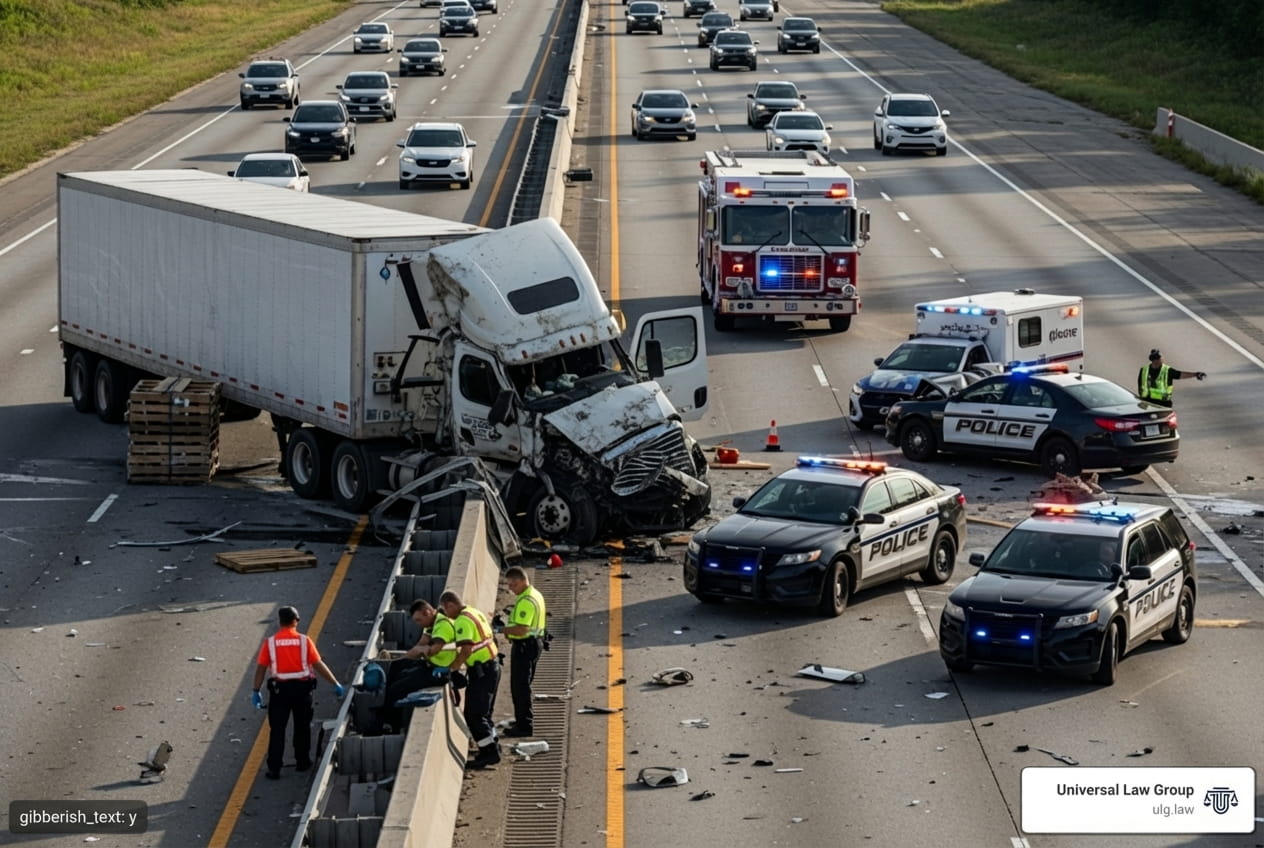
Beyond the Blind Spot: Causes of Truck Accidents
The causes of truck accidents are complex, ranging from driver error and equipment failure to systemic company negligence and poor road conditions. Understanding these factors is vital, as a collision between an 80,000-pound commercial truck and a 3,000-pound car has catastrophic consequences. Every year in the United States, crashes involving large trucks result in approximately 5,000 fatalities, with the overwhelming majority of victims being occupants of smaller passenger vehicles, according to the National Highway Traffic Safety Administration (NHTSA).
From our perspective as a Texas personal injury law firm, these crashes are often the predictable outcome of choices made by drivers, trucking companies, and sometimes manufacturers or government entities. When we investigate a truck crash, we look not just at what happened in the last few seconds before impact, but at the decisions and systemic failures that may have been building risk for weeks or months beforehand.
While driver error is the primary factor in 87% of crashes, according to the Federal Motor Carrier Safety Administration’s (FMCSA) Large Truck Crash Causation Study (LTCCS), the reality is often more complicated. Multiple factors—such as a fatigued driver, poorly maintained brakes, an overloaded trailer, and an unrealistic delivery schedule—can converge to cause a single, devastating event.
Why Truck Accident Liability Is More Complicated Than Car Crashes
Unlike standard car accidents, truck crashes can involve many potentially responsible parties: the driver, the trucking company, the cargo loader, a parts manufacturer, a maintenance contractor, or even a government entity in charge of road design and maintenance. These commercial operations must follow federal rules like the Federal Motor Carrier Safety Regulations (FMCSR), along with state laws such as the Texas Transportation Code.
Because Texas is a major freight corridor—with busy interstates like I-10, I-45, I-35, and I-69 carrying high volumes of commercial traffic—the risk of serious truck crashes on our roads is significant. In the sections that follow, we explain the most common causes of truck accidents we see in our practice and why a thorough legal investigation is essential to protecting your rights under Texas law.

Driver Error: The Overwhelming Factor in the Causes of Truck Accidents
When we investigate the causes of truck accidents for our clients, driver error is the most prevalent factor we uncover. The Federal Motor Carrier Safety Administration’s (FMCSA) Large Truck Crash Causation Study (LTCCS) found that driver error was the critical reason in 87% of large truck crashes studied. These errors often reflect a mix of intense job pressures, fatigue, and lapses in judgment that become deadly when an 80,000-pound vehicle is involved.
The LTCCS groups driver errors into four categories: Non-performance (falling asleep, physical impairment), Recognition (inattention, distraction), Decision (misjudging speed or distance, driving too fast), and Performance (overcorrecting, poor directional control). For a detailed analysis, see The Large Truck Crash Causation Study – Analysis Brief.
Driver Fatigue

Driver fatigue is one of the most dangerous causes of truck accidents. Although federal Hours of Service (HOS) rules limit driving to 11 hours after 10 consecutive hours off duty, economic pressure and tight delivery windows can encourage violations. Studies show that going 18-24 hours without sleep can cause impairment comparable to having a blood alcohol concentration near the legal limit.
When we handle a truck accident case, we obtain and analyze electronic logging device (ELD) data, fuel receipts, GPS records, and dispatch communications. We look at whether the trucking company pressured the driver to violate HOS rules, monitored logs properly, or had a history of violations. These failures help us establish not just driver negligence but also corporate negligence and potentially gross negligence under Texas law.
Distracted Driving
Distracted driving is a pervasive problem in commercial trucking. Federal regulations prohibit handheld cell phone use and texting while driving a commercial motor vehicle. The Institute for Safer Trucking reported that distracted truck drivers were involved in 248 fatal crashes in 2020 alone. The LTCCS found that “inadequate surveillance” was a factor in 14% of large truck crashes.
We secure phone records, dash-cam footage, and telematics data to establish distraction. Trucks also have large blind spots that require constant mirror checking and proper lane-change protocol. When drivers fail to account for these blind spots, smaller vehicles can easily be struck.
Speeding and Aggressive Driving
Speeding is particularly dangerous because a fully loaded tractor-trailer requires 20-40% more distance to stop than a passenger car. The LTCCS identified “traveling too fast for conditions” as a factor in 23% of large truck crashes. A 2022 Safer Trucking Report showed a 164% surge in fatalities from 2011-2020 on roads with speed limits of 75 mph or higher.
We prove speed and aggressive driving through event data recorder downloads, GPS reports, video surveillance, and eyewitness testimony. When a truck driver chooses speed over safety, and their employer fails to monitor those habits, both can be held liable in Texas.
Driving Under the Influence
Commercial drivers face stricter standards—a Blood Alcohol Concentration (BAC) of 0.04% or higher is considered legally impaired, half the limit for non-commercial drivers. While illegal drug and alcohol use was less prevalent among truck drivers, prescription and over-the-counter drugs were associated with over 26% of truck drivers in two-vehicle crashes.
In DUI-related cases, we focus on toxicology reports, DOT drug and alcohol testing history, the company’s adherence to mandatory testing programs, and prior incidents that may show negligent hiring or retention.
Equipment Failure and Maintenance Negligence
Beyond driver error, mechanical failures are significant causes of truck accidents. Under the Federal Motor Carrier Safety Regulations (FMCSR), carriers and drivers must systematically inspect, repair, and maintain all motor vehicles. Despite these requirements, our firm routinely finds inspection reports that were rushed, incomplete, or falsified.
When mechanical failure contributes to a crash, liability may extend to the trucking company, a third-party maintenance shop, or a manufacturer.
Brake Problems
Brake failure is one of the leading vehicle-related causes. The LTCCS found that brake problems were a factor in nearly 30 percent of the trucks in its crash sample. Common problems include out-of-adjustment brakes, worn pads or drums, air leaks, and overheating on long downgrades.
We work with brake experts to examine inspection records, roadside reports, and post-crash brake measurements. If a carrier puts a truck with known brake issues back into service, that conduct can constitute evidence of reckless disregard for safety.
Tire and Wheel Failures
Tire blowouts at highway speeds can cause jackknifes, rollovers, or multi-vehicle collisions. These failures often result from under-inflation, excessive wear, overloading, or defective recapped tires. We have seen cases where entire wheel assemblies separate due to improper installation or worn components.
We focus on maintenance logs, manufacturer guidelines, and compliance with inspection requirements. If evidence points to a design defect, we may pursue a separate product liability claim.
Other Critical System Failures
Other mechanical issues include steering and suspension failures that make trucks impossible to control, defective lighting that renders trucks nearly invisible at night, and coupling failures that cause trailers to detach. Equipment-failure cases require immediate evidence preservation, including sending spoliation letters to prevent destruction of critical evidence.
Systemic Failures: Company Policies, Training, and Cargo Handling
In many Texas truck accident cases, the root causes of truck accidents lie within the trucking company itself. Systemic failures—negligent hiring, poor training, improper cargo handling, and dangerous company policies—can create an environment where serious crashes are almost inevitable.
Under Texas law, these systemic issues can support claims for negligent hiring, training, supervision, retention, and in extreme cases, gross negligence.
Inadequate Driver Training and Supervision
Operating an 18-wheeler safely requires extensive, specialized training. Some companies rush new drivers through bare-minimum training programs, which is especially dangerous when drivers are new to interstate driving, hauling hazardous materials, or operating in congested metro areas like Houston.
The LTCCS associated unfamiliarity with the roadway with 22% of large truck crashes. We obtain personnel files, training records, and safety manuals to determine whether the company properly vetted the driver’s background, provided adequate training, and monitored safety performance.
Improper Cargo Loading: One of the Most Overlooked Causes of Truck Accidents
Improperly loaded freight is a dangerous and common cause of serious crashes. Overweight trucks strain brakes, tires, and suspension components, greatly increasing failure risk. Unbalanced or shifting loads can alter the truck’s center of gravity, making it prone to tipping.
The LTCCS found that cargo shift was a highly significant factor when present, increasing crash risk enormously. Liability can extend to third-party loading crews, shippers, or brokers. We retain cargo-securement experts to evaluate compliance with FMCSR rules.
Unrealistic Schedules and Dangerous Compensation Models
Many drivers are paid by the mile or delivery, encouraging them to drive faster than safe, skip rest breaks, or forgo inspections. Some companies set virtually impossible delivery schedules.
We examine dispatch records, pay structures, and internal policies about on-time performance. When evidence shows a company’s business model forces unsafe behavior, we argue the company bears significant responsibility. Our experience with complex car accidents and commercial vehicle cases helps us identify these underlying systemic causes.
External Factors and Determining Fault
Road and Weather Conditions
While driver conduct and vehicle condition are primary causes of truck accidents, external conditions also play a role. Poor road design or maintenance can be especially hazardous, including sharp curves, steep grades, potholes, and obscured signage. The LTCCS noted “roadway problems” were an associated factor in 20% of large truck crashes.
Texas experiences diverse weather conditions—heavy rain, fog, high winds, ice—that can all contribute to crashes. While weather itself is not “negligent,” a truck driver’s response can be. Federal regulations require drivers to adjust their driving to conditions and sometimes stop operating if conditions become too hazardous.
Who is Liable in a Truck Accident?
Unlike simple car crashes, truck accidents often point to multiple liable parties. Determining fault requires thorough investigation into a complex chain of responsibility:
| Potentially Liable Party | Reasons for Liability |
|---|---|
| Truck Driver | Driver error, violation of traffic laws or FMCSR rules |
| Trucking Company | Negligent hiring, training, supervision; unrealistic schedules; maintenance failures; vicarious liability |
| Cargo Loader/Shipper | Improperly loaded or unsecured cargo; overweight loads |
| Manufacturer | Defective truck parts, design flaws |
| Maintenance Shop | Negligent inspections or repairs |
| Government Entity | Poor road design or maintenance (where liability is allowed by law) |
Proving fault requires more than a police report. We conduct comprehensive investigations involving scene inspections, electronic data collection, document requests, and expert testimony. In Texas, we also analyze comparative fault—a victim’s recovery can be reduced if partially at fault, and barred entirely if more than 50% at fault.
Victims often suffer devastating harm, such as traumatic brain injuries or severe burns. Our priority is ensuring full compensation for medical care, lost income, and lifelong needs. Learn more about how we assist clients with severe injuries on our page about brain injuries from accidents.
Frequently Asked Questions about the Causes of Truck Accidents
What are the main differences between truck accident and car accident causes?
The primary differences involve vehicle size, regulatory framework, and potentially responsible parties. Commercial trucks can weigh up to 80,000 pounds, resulting in far more severe injuries. They’re governed by the Federal Motor Carrier Safety Regulations (FMCSR) and Texas state rules that don’t apply to passenger vehicles. Truck accident investigations involve unique evidence like ELD records, maintenance logs, and black box data. Liability can extend to multiple parties beyond just drivers.
What is the Large Truck Crash Causation Study (LTCCS)?
The LTCCS is a landmark FMCSA and NHTSA research project that analyzed approximately 963 serious large truck crashes. It distinguished between “critical reasons” for crashes and “associated factors,” finding driver error was the critical reason in 87% of studied crashes. Read the official summary: The Large Truck Crash Causation Study – Analysis Brief.
What steps can prevent truck accidents?
Preventing truck accidents requires comprehensive approaches including thorough driver training, strict adherence to Hours of Service rules, zero-tolerance for impairment, regular maintenance on critical systems, adoption of safety technologies like automatic emergency braking, realistic delivery schedules, and strong regulatory enforcement. When companies disregard these measures and crashes occur, civil lawsuits provide compensation to victims and encourage safer industry practices.
Frequently Asked Questions about the Causes of Truck Accidents
What are the main differences between truck accident and car accident causes?
Although car and truck accidents can share some causes—like speeding or distracted driving—the context is very different. The primary differences involve the vehicle’s size and complexity, the regulatory framework, and the number of potentially responsible parties.
- Size and Severity: A fully loaded commercial truck can weigh up to 80,000 pounds under federal law. Because of this massive size difference, collisions with passenger vehicles often result in far more severe injuries and fatalities for occupants of smaller cars.
- Regulatory Oversight: Commercial trucks and drivers are governed by the Federal Motor Carrier Safety Regulations (FMCSR) and, in Texas, by state rules and the Texas Transportation Code. These regulations cover driver qualifications, drug and alcohol testing, hours of service, vehicle maintenance, cargo securement, and more—rules that do not apply to ordinary passenger vehicles.
- Evidence and Causation: Truck accident investigations involve unique evidence such as electronic logging device records, driver qualification files, maintenance logs, dispatch communications, and “black box” data, in addition to the usual police reports and witness statements.
- Multiple Parties: In a car‑on‑car crash, liability often involves just the two drivers. In a truck crash, responsibility can extend to the driver, the motor carrier, the company that owns or leases the truck or trailer, a loading facility, a repair shop, a manufacturer, and even brokers or shippers.
Because of these factors, truck accident cases require legal counsel who understands both the trucking industry and Texas personal injury law. The severity of injuries, such as catastrophic spinal or burn injuries from fuel‑fed fires, also requires a firm prepared to pursue long‑term medical and economic damages.
What is the Large Truck Crash Causation Study (LTCCS)?
The Large Truck Crash Causation Study (LTCCS) is a landmark research project conducted by the FMCSA and NHTSA in the United States. It analyzed approximately 963 serious large truck crashes—those involving at least one large truck and a fatality or injury—to better understand the factors that lead to these events.
The study’s key contributions include:
- Distinguishing between the “critical reason” for a crash (the immediate event, such as running a red light) and “associated factors” (underlying conditions, such as fatigue or brake problems).
- Finding that driver error was the critical reason in 87% of studied crashes.
- Identifying common associated factors, including brake problems, roadway issues, fatigue, and traveling too fast for conditions.
We regularly reference the LTCCS in our work because it provides a scientifically grounded framework for understanding the complex causes of truck accidents. You can read the official summary here: The Large Truck Crash Causation Study – Analysis Brief.
What steps can prevent truck accidents?
Preventing truck accidents requires a comprehensive approach that involves drivers, trucking companies, manufacturers, regulators, and the motoring public. From our perspective as a law firm, some of the most important safety measures include:
- Driver and Company Accountability:
- Thorough and ongoing driver training and evaluation.
- Strict adherence to Hours of Service (HOS) rules to combat fatigue.
- Zero‑tolerance policies for impairment by alcohol, illegal drugs, or unsafe use of prescription medications.
- Careful hiring and screening practices to avoid hiring drivers with dangerous histories.
- Rigorous Maintenance and Use of Technology:
- Regular, documented inspections and preventative maintenance on critical systems like brakes, tires, steering, and lighting.
- Adoption of advanced safety technologies, such as automatic emergency braking (AEB), electronic stability control (ESC), lane‑departure warning systems, and blind‑spot monitoring.
- Safe Scheduling and Compensation Practices:
- Realistic delivery schedules that do not pressure drivers to speed or skip rest breaks.
- Compensation structures that do not reward unsafe behavior or excessive hours.
- Regulatory Enforcement and Public Awareness:
- Strong enforcement of FMCSR and Texas state regulations by agencies such as FMCSA and TxDOT.
- Public education campaigns to help passenger vehicle drivers understand how to share the road safely with large trucks—for example, avoiding truck blind spots, not cutting off trucks, and allowing extra room for wide turns.
When trucking companies and drivers disregard these safety measures and a crash occurs, civil lawsuits can serve a dual purpose: providing compensation to injured victims and families, and encouraging safer practices throughout the industry by holding negligent parties financially accountable.
If you have specific questions about the causes of truck accidents in your own case or how Texas law may apply, our team can evaluate your situation and explain your legal options.
How a Houston Truck Accident Lawyer Can Help
If you or a loved one has been involved in a truck accident in Houston or anywhere in Texas, the aftermath can be overwhelming. Victims are often dealing with severe injuries, mounting medical bills, lost wages, and the emotional trauma of a life‑changing event. Meanwhile, trucking and insurance companies are already working to protect their interests. As a law firm that regularly handles complex truck accident cases, our role is to level the playing field.
Our team understands the intricate causes of truck accidents and how to build a powerful case under Texas law. When you retain us, we take immediate, concrete steps to protect your rights and position your claim for the strongest possible outcome.
Truck accident cases are fundamentally different from ordinary car wrecks. They require a firm that understands trucking regulations, has the resources to take on national carriers and their insurers, and is prepared to litigate complex cases in Texas courts.
You do not have to face the trucking industry alone. Our Houston‑based team represents clients throughout Texas and is committed to providing personalized, attentive representation from your first call through the resolution of your case.
Contact a Houston truck accident lawyer for a free consultation today. We can review the causes of your truck accident, explain your legal options, and begin the process of protecting your rights and pursuing the compensation you deserve.
About the Author

