

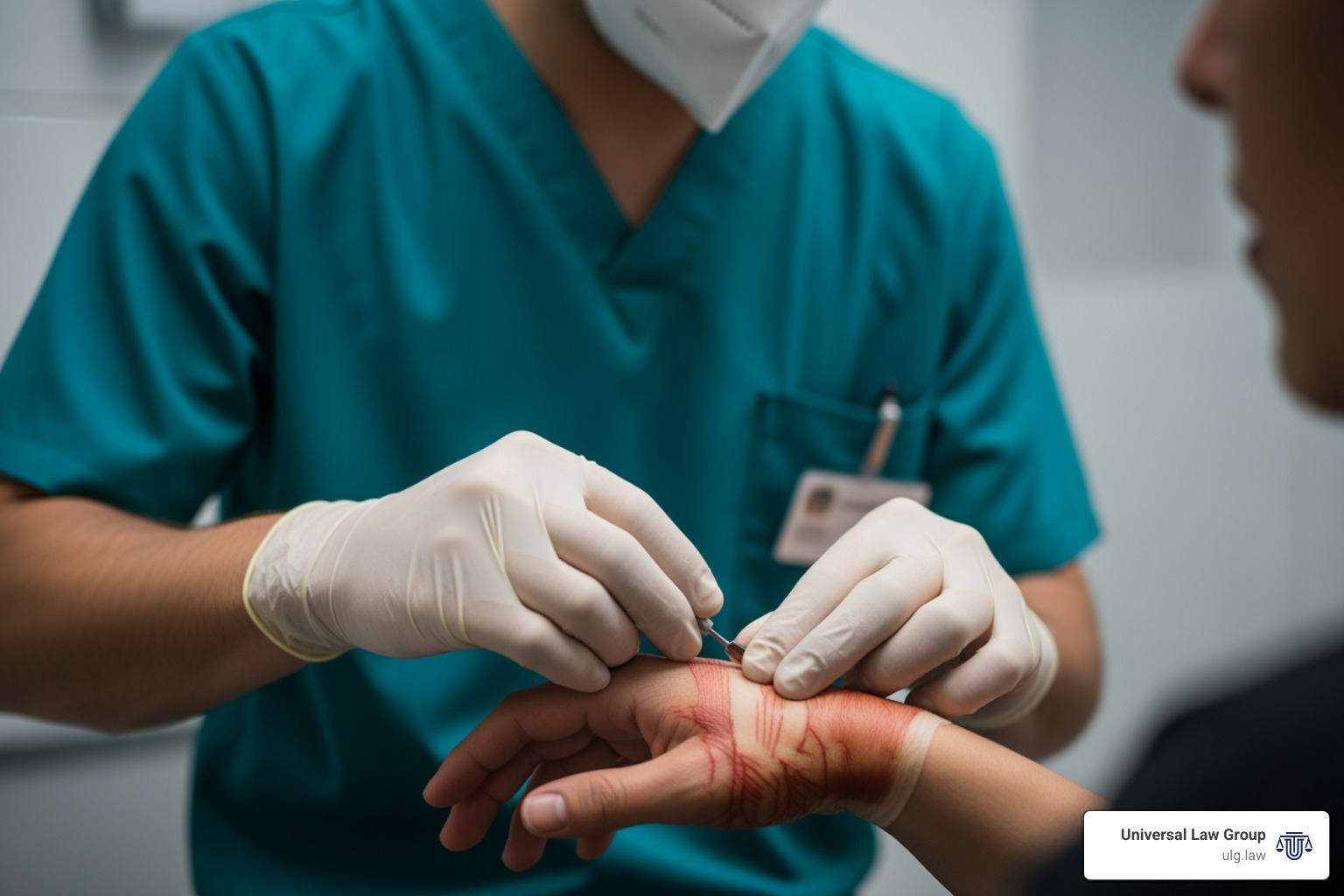
An Essential Guide to Degloving Injury
The Devastating Reality of Degloving Injuries
A degloving injury is a severe traumatic wound where the top layers of skin and tissue are forcibly torn away from the underlying muscle, connective tissue, or bone. This catastrophic injury can occur in two forms:
- Open Degloving Injury: Skin is visibly peeled away, exposing muscle, tendons, connective tissue, and sometimes bone underneath. The skin may be completely removed or hanging as a flap.
- Closed Degloving Injury (Morel-Lavallée Lesion): The skin remains intact but separates internally from deeper tissue layers, creating a space that fills with blood, lymph, and liquefied fat. These injuries often appear as bruising and swelling and are harder to diagnose.
- Common Causes: High-energy trauma such as motorcycle accidents, industrial machinery incidents, severe car crashes, falls from significant heights, and serious animal attacks.
Why It’s Serious
Degloving injuries are medical emergencies that can be life-threatening due to severe blood loss, high infection risk (including deadly necrotizing fasciitis), and potential tissue death. They require immediate emergency care and often multiple surgeries, extensive rehabilitation, and leave victims with permanent scarring, disfigurement, and functional limitations.
These injuries represent some of the most challenging cases in trauma medicine and personal injury law. When skin and soft tissue are violently separated from the body through shearing forces—whether from being dragged across pavement in a motorcycle accident, caught in industrial equipment, or crushed in a collision—the resulting damage extends far beyond what’s visible on the surface. The path to recovery is long, painful, and extraordinarily expensive, often requiring specialized burn center care, reconstructive surgery, skin grafts, and months to years of physical therapy.
Key Takeaways
- Degloving injuries are medical emergencies that require immediate care — These injuries involve skin and tissue separation, leading to severe blood loss, infection risk, and potential tissue death if not treated quickly.
- There are two distinct types with different risks — Open injuries expose underlying tissue, while closed injuries (Morel-Lavallée lesions) are harder to detect and often delayed in diagnosis.
- Recovery is long, complex, and costly — Most cases require multiple surgeries, skin grafts, and months to years of rehabilitation, with a high likelihood of permanent scarring or functional loss.
- Complications can be life-threatening without proper treatment — Risks include infection, necrosis, compartment syndrome, and chronic pain, making early intervention critical for survival and outcomes.
- Legal action may be necessary to cover full damages — Victims often face significant medical costs, lost income, and long-term care needs, so pursuing compensation can be essential for recovery.
At Universal Law Group, our personal injury team has represented many clients who have suffered devastating degloving injuries caused by workplace negligence, vehicle accidents, and defective equipment. We understand the overwhelming medical, financial, and emotional challenges these catastrophic injuries impose on victims and their families.

Understanding the Types and Causes of a Degloving Injury
A degloving injury is a severe form of soft tissue trauma that gets its name from the way skin is “gloved off” or peeled away from underlying tissues. This type of injury results from extreme shearing or tangential forces that cause the layers of skin and subcutaneous fat to separate from the deeper fascia and muscle. The consequences can be devastating, impacting not just the physical integrity of the body but also the long-term quality of life for those affected.

The mechanism behind a degloving injury is typically high-energy trauma. When an external force acts parallel to the body’s surface, it can tear the skin and its underlying layers away from the muscle and bone. This shearing force disrupts the intricate network of blood vessels and nerves that supply the skin, leading to potential tissue death and a host of complications. The severity of the injury often depends on the force involved, the area of the body affected, and whether the injury is open or closed.
Open Degloving Injuries: The Visible Trauma
An open degloving injury is perhaps the most graphic and immediately recognizable form of this trauma. In these cases, the skin and fat are openly torn and peeled back, leaving the underlying structures exposed. We often see the muscle, tendons, connective tissue, and sometimes even bone laid bare. The skin may be completely ripped away from the body, an event known as complete avulsion, or it might remain partially attached as a flap of tissue.
Common locations for open degloving injuries include the extremities (arms and legs), hands, feet, and scalp. One particularly severe and well-known example is a ring avulsion injury, where a ring on a finger gets caught and forcefully pulled, stripping the skin, soft tissues, and sometimes even bone from the finger. This can result in amputation or a complex reconstructive challenge. The immediate danger with open injuries includes significant blood loss and a high risk of infection due to the direct exposure of internal tissues to the environment.
Closed Degloving Injuries: The Hidden Danger (Morel-Lavallée Lesion)
In stark contrast to open injuries, a closed degloving injury is much harder to detect and is often referred to as a “hidden danger.” The most common type of closed degloving injury is known as a Morel-Lavallée lesion (MLL). This occurs when the skin and subcutaneous fat are separated from the deep fascia, but the outer skin remains intact. Because there’s no open wound, the injury isn’t immediately obvious, making diagnosis more challenging.
The pathophysiology of an MLL involves the shearing forces creating a potential space between the superficial and deep fascial layers. This space then fills with a collection of blood, lymph, and liquefied fat, leading to swelling and bruising. Over time, a fibrous capsule can form around this fluid collection, making it a chronic lesion. According to medical literature, Morel-Lavallée lesions are associated with pelvic trauma in 30% of cases and thigh trauma in 20% of cases. The insidious nature of these injuries means that accurate diagnosis is delayed in up to one-third of patients, often leading to more complex treatment down the line. For a more comprehensive understanding of these challenging lesions, we recommend consulting medical resources such as A comprehensive review of Morel-Lavallée Lesions.
Common Causes Leading to a Degloving Injury
Degloving injuries almost invariably result from high-impact events or severe trauma where significant force is applied to the body. These are not minor scrapes; they are serious injuries that can have life-altering consequences. Our experience representing clients in Houston, Texas, shows us that these injuries often stem from:
- Motorcycle Accidents: Motorcyclists are particularly vulnerable to degloving injuries due to the lack of protective enclosure. If you or a loved one has been involved in such an incident, understanding your rights is crucial. We offer Help for motorcycle accident victims.
- Car and Truck Accidents: High-speed collisions, rollovers, or instances where a body part is crushed or dragged can lead to degloving injuries. The immense forces involved in these accidents are more than enough to cause skin and tissue to separate from underlying structures. For those impacted by such events, our firm provides Legal support for truck accidents.
- Industrial, Farm, and Construction Accidents: Workplaces involving heavy machinery, conveyor belts, or equipment with moving parts pose a significant risk. Hands, arms, or legs caught in machinery can suffer devastating degloving injuries. These incidents often highlight failures in workplace safety protocols.
- Falls from a Significant Height: High-impact falls, such as those from ladders, scaffolding, or roofs, can cause the body to hit a surface with enough force to create shearing injuries.
- Severe Animal Attacks: While less common, powerful animal bites, especially from large dogs, can exert enough force to tear away large sections of skin and tissue, resulting in a degloving injury. If you’ve been a victim of such an attack, knowing What to do after a dog bite can guide your next steps.
These incidents underscore the need for immediate medical attention and, often, a thorough investigation into the circumstances that led to the injury.
Diagnosis and Immediate Medical Concerns
The diagnosis and subsequent management of a degloving injury are critical, given the potential for severe complications and long-term disability. Prompt and accurate assessment, particularly in the chaotic environment of an emergency room, is essential. Our firm understands that time is of the essence, and a multidisciplinary trauma team is often required to address these complex injuries effectively.

Identifying a Degloving Injury: Signs and Symptoms
For open degloving injuries, the signs are usually unmistakable: a large, gaping wound, severe bleeding, and visible underlying structures such as muscle, tendon, or bone. The skin might be completely detached or hanging as a flap.
Closed degloving injuries, or Morel-Lavallée lesions, present a more subtle and challenging diagnostic picture. Because the skin remains intact, outward signs might initially be limited to significant bruising (ecchymosis) and swelling (edema). However, careful examination can reveal a soft, fluctuant (fluid-filled) swelling, and a characteristic “wobble” sign, where the skin moves abnormally over the underlying tissues. Patients may also experience pain and decreased skin sensation in the affected area. The challenge with these hidden injuries is significant; medical literature indicates that diagnosis of Morel-Lavallée lesions is delayed in up to one-third of patients, often because the initial bruising masks the underlying damage. This delay can lead to increased complications.
The Crucial Role of Medical Imaging in Diagnosis
While a thorough physical examination is the first step, medical imaging plays a pivotal role in confirming a degloving injury, especially closed ones, and in assessing the full extent of the damage.
- Physical Examination: Beyond visual inspection, assessing skin viability is crucial. Subjective criteria like skin color, temperature, capillary refill, and bleeding upon incision are used, but these can be difficult to interpret accurately, particularly in the acute setting.
- Ultrasound: This is often used as an initial diagnostic tool, especially for Morel-Lavallée lesions, as it can quickly identify fluid collections beneath the skin.
- Computed Tomography (CT): CT scans are valuable for identifying associated injuries, such as fractures, and can show the presence of fluid collections.
- Magnetic Resonance Imaging (MRI): MRI is considered the gold standard for evaluating soft tissue injuries like degloving injuries. It provides detailed images of the separation planes, the contents of the fluid collection (blood, lymph, fat), and the formation of any fibrous capsule in chronic lesions. The Mellado-Bencardino classification system, based on MRI findings, helps categorize Morel-Lavallée lesions by age, size, and shape, guiding treatment decisions.
Potential Complications and Emergency Response
The immediate and long-term complications of a degloving injury are severe and can be life-threatening.
- Immediate Risks: The primary concern in acute open degloving injuries is hypovolemic shock due to massive blood loss. These injuries often involve significant damage to blood vessels, leading to rapid and dangerous blood loss.
- Subsequent Complications:
- Infection: With extensive tissue damage and exposure, the risk of infection is exceptionally high. This can range from localized infection to deadly conditions like sepsis or necrotizing fasciitis, a rapidly spreading bacterial infection that destroys flesh.
- Skin Necrosis: Disruption of the blood supply to the avulsed skin often leads to tissue death (necrosis), requiring further debridement and reconstructive efforts.
- Compartment Syndrome: Swelling and fluid accumulation in closed compartments of the body can put pressure on nerves and blood vessels, leading to severe tissue damage.
- Pseudocapsule Formation: In chronic Morel-Lavallée lesions, a tough fibrous capsule can form around the fluid collection, making treatment more challenging.
- Long-Term Issues: Patients frequently face chronic pain, permanent disfigurement, extensive scarring, and significant loss of function in the affected body part. The psychological impact, including post-traumatic stress disorder (PTSD), anxiety, and depression, is also profound, as the injury serves as a constant, painful reminder of a traumatic event.
Comprehensive Treatment and Management Strategies
The treatment of a degloving injury is complex, often requiring multiple surgeries and a highly coordinated effort from a multidisciplinary medical team. The overarching goals are to preserve life, salvage the limb or affected body part, restore function, and minimize long-term disability and disfigurement. This typically involves trauma surgeons, orthopedic surgeons, and plastic surgeons working in tandem.
Treating Open Degloving Injuries
Open degloving injuries demand immediate and aggressive intervention:
- Emergency Stabilization: The first priority is controlling hemorrhage and stabilizing the patient. This includes fluid resuscitation and administering broad-spectrum intravenous antibiotics to prevent infection.
- Surgical Debridement: Nonviable and contaminated tissue must be aggressively removed. This is a critical step to prevent infection and promote healing.
- Replantation/Revascularization: If the avulsed skin flap has a viable blood supply or if its vessels can be surgically reconnected (revascularization), replantation is attempted to restore the original tissue.
- Skin Grafting: When replantation is not possible or successful, skin grafting is commonly used. This involves transplanting skin from a healthy donor site on the patient’s own body (autograft) to cover the wound. Both split-thickness grafts (epidermis and part of the dermis) and full-thickness grafts (epidermis and entire dermis) may be used depending on the defect.
- Flap Surgery: For complex defects where deeper tissues are exposed or where more robust coverage is needed, flap surgery may be performed. This involves transferring a section of skin, muscle, or other tissue, along with its own blood supply, from another part of the body.
- Amputation: In cases where the limb or digit is severely damaged, infected beyond control, or its blood supply cannot be restored, amputation may be a necessary last resort to save the patient’s life or prevent further complications.
The therapeutic challenges associated with these injuries are profound, as highlighted in medical literature such as The therapeutic challenges of degloving soft-tissue injuries.
Managing Closed Degloving Injuries (Morel-Lavallée Lesions)
Treatment for Morel-Lavallée lesions (MLLs) varies depending on the size, age, and presence of a fibrous capsule, as well as associated injuries:
- Conservative Treatment: For small, acute lesions with minimal fluid accumulation and no fibrous capsule, conservative management may be attempted. This typically involves compression therapy (e.g., elastic bandages), rest, and careful observation.
- Minimally Invasive Procedures: For larger or persistent fluid collections, percutaneous aspiration can be performed, where a needle is used to drain the fluid. Sometimes, an indwelling catheter may be placed for continuous drainage.
- Sclerodesis: For recurrent MLLs, sclerodesis involves injecting a sclerosing agent (such as doxycycline, ethanol, or talc) into the fluid cavity. This causes irritation and inflammation, leading to scarring and adhesion of the tissue layers, closing the potential space.
- Surgical Intervention: Open surgery is indicated for large, chronic, or infected MLLs, or those associated with significant tissue damage or underlying fractures. This involves making an incision, draining the fluid, thorough debridement of any necrotic tissue, and complete excision of the fibrous pseudocapsule. Techniques like quilting sutures may be used to re-approximate the skin to the deep fascia, eliminating the dead space.
A practical review of the comprehensive management of these lesions emphasizes the need for a custom approach, as detailed in resources like A practical review of managing Morel-Lavallée Lesions.
Recovery, Long-Term Outlook, and Legal Considerations
The journey after a degloving injury extends far beyond the operating room. It is a long, arduous, and often incredibly expensive road to recovery, impacting every aspect of a victim’s life. At Universal Law Group, we understand that addressing the physical and non-physical damages is crucial for true healing and justice.
The Road to Recovery: Rehabilitation and Long-Term Care
The immediate aftermath of a severe degloving injury often involves an extended hospital stay, sometimes lasting weeks or even months, depending on the severity and location of the injury. Patients typically undergo multiple surgeries—not just for initial repair but also for subsequent debridement, grafting, or flap revisions.
- Physical and Occupational Therapy: Essential for regaining mobility, strength, and function in the affected body part. This can be a grueling process, requiring immense dedication and resilience.
- Scar Management: Degloving injuries almost always result in significant scarring and potential disfigurement. Scar management techniques, including pressure garments, massage, silicone sheets, and laser therapy, may be employed to improve the appearance and flexibility of scars.
- Chronic Pain Management: Many individuals experience chronic pain that can persist for years, requiring ongoing medical management and support.
- Psychological Impact: The emotional and psychological toll of a degloving injury can be profound. Dealing with visible disfigurement, loss of function, and the trauma of the accident itself can lead to PTSD, anxiety, depression, and significant body image issues. Studies have shown that individuals with visible scarring or disfigurement, especially facial, are more prone to anxiety and depression and may face societal challenges, such as decreased trust from others. Comprehensive psychological support is often a critical, yet overlooked, part of recovery.
- Long-Term Prognosis: The long-term functional outcomes vary widely depending on the injury’s extent, location, and the success of treatment. While complete recovery is the goal, some degree of permanent impairment, disfigurement, or chronic pain is common.
Understanding Your Legal Rights After a Degloving Injury
- Negligence as the Basis for a Claim: To secure compensation, we must prove that another party’s negligence directly caused your injury. This could involve a careless driver, a negligent property owner, a manufacturer of defective equipment, or an employer who failed to maintain a safe workplace.
- Types of Damages to Pursue: A comprehensive personal injury claim for a degloving injury aims to cover all losses, both economic and non-economic. These typically include:
- Past and Future Medical Expenses: Covering emergency care, surgeries, hospital stays, medications, rehabilitation, physical therapy, psychological counseling, and any future medical needs related to the injury.
- Lost Income and Earning Capacity: Compensation for wages lost due to time off work and for any diminished ability to earn income in the future.
- Pain and Suffering: Acknowledging the physical pain endured from the injury, surgeries, and recovery.
- Mental Anguish: Addressing the severe emotional and psychological distress caused by the trauma, disfigurement, and life changes.
- Disfigurement: Texas law recognizes disfigurement as a distinct damage element, compensating for the impairment of beauty, symmetry, or appearance caused by scarring and tissue loss.
- Loss of Consortium: For spouses, compensation for the loss of companionship and support due to the injury.
- Statute of Limitations in Texas: It’s crucial to act promptly. In Texas, there is generally a two-year statute of limitations for most personal injury claims, meaning you typically have two years from the date of the injury to file a lawsuit.
- Importance of Preserving Evidence: We work diligently to gather and preserve all relevant evidence, including accident reports, medical records, photographic evidence of the injury, witness statements, and expert testimony. This meticulous approach is vital for building a strong case.
Valuing Your Claim
The value of a degloving injury claim can vary significantly based on factors like the body part affected, the extent of repairability, the visibility of scars, the required medical care, the healing outcome, and the impact on daily activities and work. For instance, our experience suggests that a non-debilitating fingertip degloving injury could have a settlement value in the $150,000-$250,000 range, inclusive of fees and expenses. We are here to help you understand what your specific case might be worth.
Frequently Asked Questions about Degloving Injuries
Can a degloving injury heal on its own?
Small, acute closed degloving injuries (Morel-Lavallée lesions) may sometimes resolve with conservative treatment like compression. However, open degloving injuries and larger closed lesions are medical emergencies that will not heal on their own and require urgent surgical intervention to prevent severe infection, tissue death, and other life-threatening complications.
How long does it take to recover from a degloving injury?
Recovery is a long and highly individual process, often taking many months to years. It depends on the injury’s size, location, the success of initial surgeries, and whether complications arise. Most patients face multiple procedures followed by extensive physical and occupational therapy to regain as much function as possible.
Is a degloving injury considered a burn?
While a degloving injury is a traumatic avulsion, not a thermal, chemical, or electrical burn, severe cases are frequently treated in specialized burn centers. The reasons are similar: both involve massive skin and soft tissue loss, a high risk of infection, and require complex wound management and reconstructive techniques like skin grafting. For more information on related cases, you can explore Information on burn injury cases.
Degloving injuries represent one of the most severe forms of soft tissue trauma, leaving victims with profound physical, emotional, and financial burdens. These catastrophic injuries are not just medical challenges; they are life-altering events that demand immediate, expert medical attention and, in many cases, skilled legal advocacy.
We have explored the nature of these injuries, from the visible trauma of open degloving to the hidden dangers of Morel-Lavallée lesions. We’ve seen how they occur, how they are diagnosed, and the complex, multidisciplinary treatment strategies required for recovery. The path to healing is long, often marked by multiple surgeries, extensive rehabilitation, chronic pain, and the psychological weight of disfigurement.
At Universal Law Group, we firmly believe that if your degloving injury was caused by the negligence or wrongdoing of another, securing fair compensation is not just a right, but a critical step toward rebuilding your life. Our experienced team in Houston, Texas, understands the intricate medical details of these cases and the profound impact they have on victims and their families. We are here to help you understand your rights, steer the legal process, and fight tirelessly for the justice and compensation you deserve.
If you or a loved one has suffered a degloving injury, do not face this challenge alone. Let us be your advocate. Learn more about our personal injury services in Houston.
About the Author

